Showing posts with label Cold War. Show all posts

Thursday, January 2, 2014

Where Have All The Wargames Gone?

From Strategy Page:

by James Dunnigan
December 14, 2003
Commercial wargames began in the late 1950s as much simplified versions of systems used by professional soldiers for over a century. Unlike the professional games, those first commercial designs from Avalon Hill were actually historical simulations. The professional wargames concentrated on fighting tomorrow's battles, not yesterdays. Moreover, the professional games concentrated a lot of effort on tactical and operational level operations, while the first commercial wargames were largely strategic level.

There was a reason for this, and the reason was simplicity and accessibility. The professional wargames were complex beasts, requiring many hours of work to master, and equally long hours to play through. The commercial games had to be much more accessible. Even though these games were being bought by an upscale market of well educated men and teenagers, no one would have bought a game done to professional military standards. It was quickly discovered that commercial success meant a game that could be learned in less than half an hour, and played in two or three.

The early game designers were not concerned so much about complexity as they were in making the game historically realistic. This was not as easy as it looked, but most of the development effort went into creating a simulation that could, with reasonable (or at least convincing) accuracy reproduce the historical event it represented.

But then something unexpected happened. As gamers played more of the early games, they became adept at easily handling game procedures that scared off most of the population. Gamers trained themselves, by simply playing a lot, to a level where they could easily handle more complex procedures. Designers, being experienced gamers themselves, also became adept enough to create more complex games that did not collapse under mountains of procedures. The more complex games could thus cover more detail in the historical situation, but too often the more complex games were, well, simply more complex.

Then something less unexpected happened. The more complex a game was, the fewer copies were sold. Many experienced gamers who were capable of dealing with the more complex games decided that, for them, life was too short and they would just stick with the simpler games. Thus, after the first wave of complex games appeared in the mid-1970s, there was something of a backlash as gamers snapped simpler games in large quantities.

I always preferred to add as little complexity as possible to a design, in order to achieve additional (or necessary) realism or play value. I've designed a few complex games, and don't remember the process, or the results, fondly. It always seemed much ado about not much. But I was in the minority among game designers, and after I left the business in 1980, the designers of more complex games predominated. Many went on to design rules for miniatures games, an area that concentrated on detailed simulation of tactical operations.

The point of a historical simulation is to replicate the decision making process of the two commanders. This has more to do with things like decision cycles (which vary from army to army and period to period) and customs and habits among commanders (ditto.) One reason people preferred games that featured outstanding military leaders was that these guys had, in effect, "special powers." They didn't play by the rules historically, so you had to invent new game procedures to replicate the additional capabilities these Great Captains brought to the battlefield. Wellington simplified this effect somewhat when he said "Napoleon was worth 40,000 men." Napoleon was more than that, but it's true that his skills often had the same effect as giving a less able general an extra army corps or two. But a good designer would want to capture those specific skills of Napoleon (insight, speedy decision making, inspiration to troops and commanders alike, and so on) in his design. Other Great Captains would bring a different mix of magic to the battle, although I have found that there is a limited menu of skills for Great Captains to choose from. Still, players enjoyed seeing that kind of specialization.

Through the 1980s and 90s, designers concentrated on items that had previously been hidden from view. But this was often at the expense of simplicity. The details, real or imagined, of mechanized operations, intelligence play and psychological warfare became popular items for designers to spotlight. A game that paid a lot of attention to things logistics was a hard sell, even to the most experienced grognard.

The collapse of the wargame market in the 1980s gave designers an incentive to be even more creative, and they were. There was a lot more innovation in game design, and close attention paid to the shrinking pool of customers. Complex procedures were simplified and new game mechanics were used to keep players involved, without losing them in a morass of procedures. Card based games often dispensed with the map altogether. Random events became more common, and realistic. As the 80s went into the 90s, designers became, quite naturally, more skilled and resourceful.

With the appearance of the Internet, it became a lot easier for designers and publishers to be in regular contact with their customers. BBS systems and email, which proliferated in the 1980s, were limited by the relatively small number of people who were online. This changed in the 1990s and wargamers quickly became a vibrant online community. Wargames, including the manual ones, went online as well. Programs like Aide de Camp and Cyberboard allowed gamers to play their favorite manual games on a PC, and with opponents anywhere on the net. It was no longer a major chore to find live opponents.

When I started StrategyPage in 1999, part of the impetus was the proposition; what would a 21st century "Strategy & Tactics" look like? There are no games on StrategyPage, because wargames are a mature industry. This was not the case in 1999, thus there was no opportunity to do the same thing we did in 1969. Actually, we do have a unique type of wargame planned for StrategyPage, but we like to stay in the black. It's much more time consuming and expensive to create and publish a computer wargame than it is for a manual one. So it will be a while before we get the game element online.

Manual games were turned into a niche market by PCs and role playing games. That is not likely to change. Even computer versions of manual games do not have a large market because of the much greater popularity of fantasy and Science Fiction type games. This has created a situation where many of the best designers develop new game concepts for a very small segment of the game market. Stranger still, few of these ideas make it over to the more popular market segments. In the 1980s and 90s, many of the computer game developers had a background in manual wargames. But this changed as more young designers came into the business who had cut their teeth on video and PC games. Gamers who have been playing manual and computer games since the 1970s have noted that many of the earlier computer games had more meat on them (in terms of game value) than current efforts. A lot of this has to do with the appeal of eye candy (snazzy graphics), which is where a lot of the budget goes. Most current games provide more work for novelists (scenario writers) than for game designers.

Which reminds me of what I used to tell the folks at SPI during the 1970s, "these are the good old days, enjoy them while you can."

     This article is ten years old, but still rings true. I'm a small time wargamer myself, I have about a  dozen war-games of varying complexities and scenarios. In the 80s war-games really did get massively complicated. Compare Sixth Fleet to 3rd Fleet. Same series, ten years later and the game is massively more complicated. The emphasis on the minutiae of war can at times be a plus or massive negative. Now, with the advent of the Internet we have wargames like World of Tanks (which is a lot of fun, if you have a good computer), or War Thunder which allow platoon level combat on the ground or in the sky. There is no multi-hour set-up for games like 7th Fleet or SPI's Third World War, nor do online games take upwards of 24 hours to play to the end. 
      Unfortunately, there will probably never be a return of wargaming with the massive community, large number of publishers, and large selection of games that there was back in the 80s. Part of this has to do with the collapse of the USSR which removed a great deal of fodder for war-games back then. So many games were based on a U.S. vs. USSR war, with variants for all theaters. From Western Europe to the Balkans, and the Indian Ocean to the Western Pacific. Perhaps someday there might be return of wargaming with a potential U.S. vs. China war or China v.s. Russia war, but I doubt it. There simply isn't the high demand for physical war-games any more.  
     And that's a shame, because there is a unique feeling after you set up a big war-game, play it out and finish it. It's hard to explain, but it's something along the lines of that you know the time spent wargaming was time well spent.


Friday, July 19, 2013

Flashback Friday: AIR-2 Genie

      This week's Flashback Friday looks at the AIR-2 Genie. The AIR-2 was an unguided air-to-air missile deployed by the USAF from 1957-1985. The AIR-2 was armed a W25 nuclear weapon, with a yield of 1.5kT. The AIR-2 had a range of 10.8km and traveled at Mach 3.
      In the mid-1950s a major threat was a Soviet nuclear attack carried out with the Tu-4 (a B-29 clone).  Up to then U.S. fighters had been equipped with either 20mm cannons or 12.7mm machine guns, and unguided rockets like the Mk 4 FFAR. None of these were effective at shooting down aircraft, especially not high speed bombers, and true air-to-air missiles were still in their infancy. Thus, a solution was found in the AIR-2, as it was nuclear armed it could be fired into a bomber stream, and when detonated could bring a number of bombers in one detonation. The AIR-2 was only live-fired once, during the Plumbbob John nuclear test over Yucca Flats, at an altitude of 4.5km. The warhead had a yield of 1.7 kilotons.
     Video of the test can be seen from 6:00 to 6:30.
     During the test 5 USAF officers stood underneath the detonation to prove the Genie was safe for use over populated areas. Gamma and neutron radiation doses were reported as negligible.
      In the end the Genie was maintained through the 80s, and would have been at the frontline of any Soviet air attack against North America. It's effectiveness is debatable against bombers like the Tu-160 or Tu-22M, but it would have been highly effective against the Tu-95.

Thursday, July 11, 2013

Pegasus-class: The 1970s LCS

8 Harpoons, a 76mm gun, and a top speed of 48 knots. Faster and better armed than the LCS, launched in '75, decommissioned in '91.  Video shows off the Pegasus, and provides an overview of hydrofoil technology.


Video Credit: Jeff Quitney


Friday, July 27, 2012

Flashback Friday: Ulyanovsk-class

     This week the topic of discussion is the USSR's planned class of supercarriers, the Ulyanovsk-class. The Ulyanovsk-class was supposed to be a Soviet analog to the American Nimitz-class supercarriers. The main mission of the Ulyanovsk-class would have been power projection and sea control, versus ASW as with all previous Soviet carrier designs.
     The Ulyanovsk-class would have had a displacement of just under 80,000 tons fully loaded, a length of 325 meters, a beam of 40m, and a draft of 11m. The Ulyanovsk-class would have had a top speed of at least 30 knots, and crew of roughly 3,800 men. 
     As with all Soviet carrier designs the Ulyanovsk-class carried their own offensive firepower in the form of 12 SS-N-19 Shipwreck ASCMs in 12 VLS launchers between the forward catapults. The Ulyanovsk-class also carried 24 SA-N-9 Gauntlet SAMs in VLS cells scattered around the deck. However, the Ulyanovsk-class departed from previous Soviet carrier designs in that they were not equipped with ASW weapons, sonar, and large guns. 
     The lead ship of the Ulyanovsk-class, the Ulyanovsk, was under construction when the USSR collapsed in 1991, and was scrapped in 1994 and her metal sold on the world metal market, as was the metal being readied for the second ship. However, there are rumblings that the Ulyanovsk-class design may be used for China's future aircraft carriers (unfortunately the Aviation Week article that I was going to link to is no longer available, so here is a blog post I wrote a year ago with some links on the subject).
     The Ulyanovsk-class was a rather interesting aircraft carrier design, but ultimately was a colossal boondoggle for the USSR, sapping precious resources from more valuable projects. The USSR attempted to build ships that were equal to U.S. Navy ships, rather than concentrating on submarines and cruise missiles which would have been cheap and and hard to kill solutions. In other words, we out spent them, and in trying to catch up they bankrupted themselves.


Photo Credit: Harpoon HQ, K.E. Cepreeb

Tuesday, July 3, 2012

Friday, June 22, 2012

Flashback Friday 6/22: USS United States (CVA-58)

    This week's Flashback Friday looks at the USS United States, what could have been the world's first supercarrier. The USS United States was primarily envisioned as a carrier that rather than support amphibious operations or sea control, would perform nuclear bombardment as it's main mission. Later on during the design period, the United States was redesigned to carry more fighters, but her main mission overall was for nuclear bombardment.  The United States would have had a flight deck that could handle 45,500kg aircraft because of the heavy weight of early nuclear weapons (some early nuclear weapons could weigh as much as 6000kg).
      One of the unique aspects of the United States was that she was designed without an island on the flight deck. Most carriers that have been built have been constructed with an island amidships of varying sizes. The main problem with the lack of an island it that the functions performed in an island (air traffic control, combat information center, steering, among others) have to be moved belowdecks. And while this provides greater armor, it denies the captain, air boss, and others a view of their surroundings. The other problem with the lack of an island is that  there is no place to locate radar and communications antennas.
     However, what was probably the most interesting feature of the United States was the fact that she had 4 catapults on the bow and amidships, and yet was designed to be able to recover aircraft at the same time she was launching them. This was a capability not available for the U.S. Navy until 1955 on the USS Shangri-La with the SCB-125 upgrade for WWII-era Essex-class carriers. And even then modified carriers could only use 2 of 4 catapults when recovering aircraft.
     What sank the United States however, was inter-service rivalry. At the same time the United States was being designed, the Air Force had begun pushing for a fleet of B-36 Peacemakers to use in lieu of carriers for nuclear deterrence. The SecDef at the time, Louis A. Johnson, canceled the construction of the United States 5 days after her keel was laid (see picture above). This led to the famous "Revolt of the Admirals" which cost the then CNO Admiral Louis Denfield his job. However, the "revolt" saved carrier aviation, as the then-new thinking was that strategic bombing with nuclear weapons would win any future war. This was proved wrong in the Korean War a year after the United States was canceled.
     The USS United States was a revolutionary design, and could have altered the design of U.S. Navy carriers for many years afterward. However, at the same time, it might have been a good thing that she was canceled, as she was designed with nuclear deterrence in mind, rather than air support and sea control which have always been the traditional missions of an aircraft carrier. 


Tuesday, August 9, 2011

Last Week's Helicopter Crash Wasn't Caused By An RPG

     Last week a CH-47 Chinook carrying 22 SEALs, 3 Air Force Air Controllers, and 7 Afghan Army troops was shot down by the Taliban over Afghanistan. Defense News reports that the Taliban shot down the helicopter with an RPG that struck the helicopter.
     The report also says that the attack took place late August 5th, at night in other words. However, you have a better chance of finding Flight 19 with a fishing net than hitting a moving helicopter with an RPG, and there it is more likely that the Taliban used a MANPADS ( MAN Portable Air Defense System).
     A MANPADS is a a small rocket similar to an RPG, but with an infrared guidance system that locks on to the exhaust from an aircraft engine. A MANPADS that most people might have heard of is the FIM-92 Stinger. The Stinger is the standard issue MANPADS of the U.S. military and several other countries.
     The Mujaheddin (now known as the Taliban) who fought the Soviets in Afghanistan during the 1980s, received among other things Stinger MANPADS to shoot down Soviet helicopters with.  By now the batteries in those missiles are long dead, and the equipment needed for their upkeep is impossible for the Taliban to get their hands on. Thus, this would point toward a new outside source for these weapons.
     The first suspect to come to mind would be Iran, Iran has been caught before giving the Taliban weapons in the form of 122mm rockets that have a range of 13 miles. On top of this Iran is known to produce a MANPADS under the designations Misagh-1 & 2. Another possible source for MANPADS would be China, they are known to produce several types of MANPADS, and also shares a border with Afghanistan. Russia is also another possible supplier of MANPADS, but has no motive for this. Libya might also be the source for these missiles due to the fact that MANPADS have been stolen from Gaddafi armories several times, and no one knows where they are. Other more unlikely sources could be Pakistan, Uzbekistan, Tajikistan, or even India, but these countries with the exception of Pakistan, have no reason to provoke the U.S. like this.  
     Until the military comes clean and admits that the Taliban is using MANPADS this is all pure speculation, but if true this poses an enormous risk to civilian and military air travel all over the world.


Photo Credit: U.S. Air Force

Monday, July 18, 2011

The Virginia-class: The New Ohio-class

     Aviation Week reported last Thursday that the Navy was considering canceling the proposed SSBN(X) project to meet budget reduction requirements. Marine Corps Gen. James Cartwright stated at the Defense Writers Group breakfast that the Pentagon was considering lengthening Virginia-class submarines to be capable of carrying Trident C-4 SLBMs (Submarine Launched Ballistic Missiles).
     The idea of lengthening Virginia-class submarines has been discussed before, the idea being to insert an extra 27.4 meter section into a normal Virginia-class sub, and fill the section with 194  Tomahawk cruise missiles. 
     The proposal to insert SLBMs into a Virginia-class certainly has merit, but with congress in a stalemate over the debt ceiling, the chances of this happening, are slim at best.
     

Photo Credit: U.S. Navy


Tuesday, July 5, 2011

Grainy Videos Showing Officials Touring The Varyag & The Varyag's Weapons Systems

     Alert 5 spotted these two videos showing a group of officials on the Varyag's deck, and below, a video showing a HQ-10 (FL-3000), a 10 barrel gatling gun, and an unidentified rocket launcher.

Here is the video showing the tour.


And here is the video showing the Varyag's weapons.


If you made the mistake of not turning the sound off for the first video, here is the real song.


Video Credit: Alert 5 & Hans Zimmer


Tuesday, June 28, 2011

Tank Firing At 18,000 Frames Per Second

     Take a look at these videos showing a T-90 firing in slow motion.


If you thing that was cool, take a look at this.


  I did not make this or record this.

Wednesday, June 22, 2011

Varyag To Begin Sea Trials July 1st

     Defense News reports that the Chinese carrier Varyag will sail for sea trials on July 1st, but will not be officially launched until October 2012.
     With the increasing tensions in and around the Spratly Islands, the Varyag would be a powerful bargaining  tool, especially with countries like the Phillipines or Indonesia who have small and/or aging navies. However, Vietnam and Malaysia both have relatively large and new navies that if used with skill, could pose a threat to any Chinese forays into the Spratley Islands.
     With the Varyag close to sailing it will be interesting to see how other Asian countries react to the Varyag in the South China Sea.

Monday, June 20, 2011

It's Official: Russia Buys Two French Mistral-class Amphibious Assault Ships

     On Friday Russia signed a deal worth 1.6 billion dollars, for 2 Mistral-class amphibious assault ships, as Defense Tech reports. The deal also reportedly includes initial logistics, training and technology transfer. 
     The deal for 2 Mistrals has been in the works for about a year, and only now has it been completed. The deal was held up for some time over objections from former Soviet states like Estonia, Latvia, Georgia over the growing Russian military, and the threat the Mistrals would pose to them.
     The Mistral-class was developed to increase the amphibious capabilities of the French Navy and allow the French to perform raids, withdrawals and amphibious assaults. The Mistral-class can carry up to 900 troops for a short time, and between 60 and 70 vehicles. The Mistral-class can handle up to 16 medium helicopters (NH-90, Tiger) or up to 35 light helicopters, which could be stored in the hanger or on deck. The Mistral-class has a displacement of 21,300 tons with a full load, and a displacement of 16,500 tons when empty. 
     With Russia rebuilding it's military, it will be interesting to see how the former Soviet states and the world will react to this purchase.     


Photo Credit: Wikipedia

Thursday, April 28, 2011

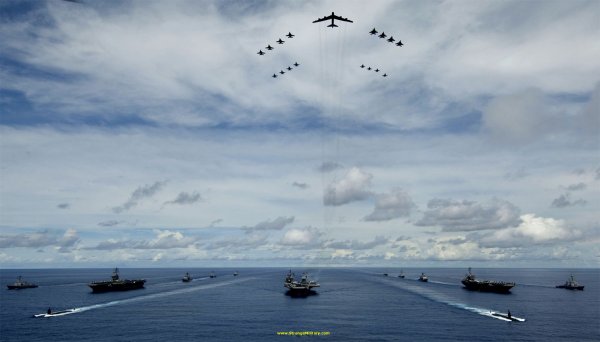
What Happend To the 600-Ship Navy?

     During the 1980s at the height of the Cold War, Ronald Reagan pushed a massive military modernization and expansion plan that for the Navy would have resulted in a 600-Ship Navy. My question is what happened to that idea?
     When the Soviet Union collapsed in 1991, governments around the world began to make massive budget cuts to their military's, one example is the so called Royal Navy and British Army, both of which are skeletons of their former selves. Since the collapse of the Soviet Union most governments have begun rearming (Britain hasn't) and putting their military's back together. Since 1991 the U.S. has expanded it's military but, the 600-Ship Navy idea is nowhere to be seen. The 600-Ship Navy has become a victim of several groups, socialists/communists who want to redistribute wealth and want a larger government, cost cutters who think now the the USSR is gone we can put the money into other programs, peace groups who think there should be no military at all and the list goes on.
      Few poeple outside the military realize how dire the situation really is, since 1987 the Navy has gone from the 1980s high of 594 ships to about 290 ships in service in 2011. Since 1987 our Navy has been more than halved and almost nobody in the media, the government or the people realizes it. Our Navy has been second to none since the end of WWII when we had over 6,000 ships and still are larger that the next seven navies combined but, China is rabidly increasing the size of their Navy and as of 2011 are second in size to only to the U.S. and climbing.
     The Navy is starting to begin building ships a higher rate in the last couple of years but, as I said a couple of articles ago the Navy is crumbling before our very eyes. And if we do not correct this situation, the cosequences could be extremly bad to say the least.


Photo credit: New Wars

Wednesday, April 27, 2011

Chinese Naval Aviation Update

    Well, folks I have it to give the ChiComms, they sure know how to deal with labor unions. Defense News reports that the head of the Taiwanese spy agency, Tsai Teh-sheng claims that the Chinese carrier Varyag will be operational by the end of this year. This a very disturbing development for every nation around the Pacific rim because prior to this Chinese air power was limited to the immediate area, now the Chinese will have the ability to project air power throughout the Pacific Ocean. 
     Tsai Teh-sheng claims are further supported by the fact the China's copy of the Su-33 has just been revealed. This new fighter has received the designation J-15 "Flying Shark" and, is probably going to constitute the core of the Varyag's air wing. Not much about the J-15 is known at the moment except, that it probably has the usual equipment used by carrier aircraft, strengthened  landing gear, longer range and possibly better engines. The possibility that the J-15 has better engines than a normal Su-27 as the Su-33 is the carrier version, is highly unlikely because the Chinese have had trouble producing a good indigenous engine for use in fighter aircraft, usually opting to purchase engines from the Russians and copy them either under license or illegally. 
     While the J-15 is a step forward for the Chinese military, the J-15 is not likely to be able to compare with the Super Hornet now in service in the U.S. Navy due to fact that Chinese pilots have had no real air-to-air combat experience since the confrontation with Taiwan in the Second Taiwan Straight Crisis in 1958. Aviation Week also reports that the J-15 is comparable with a F/A-18C which is now being replaced by the F/A-18E/F Super Hornet.
     All in all the J-15 is a step forward for the Chinese but, if push comes to shove between the U.S. and China, I don't believe the J-15 or the surface forces of the Chinese Navy are going to be a serious threat. However, as I said the Chinese surface forces won't be a "serious" threat but, they will be a threat worth keeping an eye on. 


Photo Credits (from top to bottom): Military-Today.com, Defense Tech,

Tuesday, April 26, 2011

All Our Eggs In One Basket

    As reported in my previous article "It's That Time Of Year"  I reported that the Navy was requesting (and got) 1.1 billion dollars for research on the SSBN-X-class of submarines.  The SSBN-X is a class of ballistic missile submarine slated to replece the Ohio-class SSBNs now in service with the U.S. Navy, the Navy is currently looking to replace the Ohio-class sometime during the 2020s. 
    However, during the last years of the Cold War with the Soviet Union. the Navy went through an enormous shipbuilding program intended to culminate in a 600 ship Navy in order to compete with the Soviets on the high seas. The high point of the 600-ship Navy plan was 594 ships in 1987, rising to 594 ships from the post-Vietnam low of of 521 ships.
     Because of this massive shipbuilding effort during the 1980s, a large amount of the Navy will age out during the 2020s and there is little anyone can do to stop it from happening. Furthermore, with a large part of the Navy being decommissioned it will be extremely hard for the Navy to replace the Nimitz-class aircraft carriers and the Ohio-class SSBNs at the same time. Since the SSBN-X has an estimated cost of 6-7 billion dollars apiece the SSBN-X alone would eat up a sizable portion of the Navy's shipbuilding budget, not counting the Gerald R. Ford-class aircraft carriers slated to begin replacing the Nimitz-class beginning in the 2015 and ending sometime after 2040.
     Most people might ask what is the solution to this problem? Well, for starters we could have all the Socialists/Communists sent off to Nowhere, USA and have them start a big commune and leave the rest of us alone (that's sarcasm). In reality the solution to ALL of America's budget woes is really quite simple, cut the Departments of Health and Human Services, Labor, Transportation, Housing and Urban Development, Education, Energy, Agriculture, cut about 90% of the Department of the Interior and cut the Department of Homeland Security. If all of this is done the benefits are enormous because we could pay off the debt, have money for defense and best of all have less government. However, the pies de resistance is that all of those things would become the state's responsibility as stated in the 10th amendment to the Constitution which states, "The powers not delegated to the United States by the Constitution, nor prohibited by it to the States, are reserved to the States respectively, or to the people." lav
     Which ever way the government chooses to go, they must choose quickly, because the U.S. Navy is crumbling before our very eyes.