Showing posts with label Bombers. Show all posts

Friday, January 17, 2014

Flashback Friday: Junkers Ju 390

     The Junker Ju 390, a development of the Ju 290 with an extreme range and the ability to carry a meaningful payload over that range. One of the aircraft designed from the Amerika bomber project, it was meant to have three different variants. One each for heavy transport, maritime patrol, and a heavy bomber.
     Specifications from the Luftwaffe Resource Center:

Type: Long Range Bomber or Reconnaissance aircraft.
Origin: Junkers Flugzeug und Motorenwerke AG
Models: V1 to V3 and A-1
Crew: N/A
First Flight: Prototypes only
Final Delivery: None
Number Produced: V1 and V2 Only

Engine:
Model: BMW 801E
Type: 18-Cylinder two-row radial

Dimensions:
Wing span: 165 ft. 1 in. (50.30m)
Length: 112 ft. 2.5 in. (34.20m)
Height: 22 ft. 7 in. (6.89m)

Weights:
Empty: 81,350 lb. (36,900 kg)
Loaded: 166,448 lb. (75,500 kg)


Performance:
Maximum Speed:
    Clean: 314 mph (505 kph)
    Max. Ext. Load: 267 mph (430 kph)
Service Ceiling (Typical): N/A
Range in Recce configuration:
    6,027 miles (9700 km)
Endurance in Recce configuration:
  32 Hours
Payload:
Transport (V1): 22,046 lb. (10,000 kg)
Bomber (V3): 3,968 lb. (1800 kg)

     Just looking at the specification of the Ju 390 it is an excellent reconnaissance/patrol aircraft. Extremely long legs, and a relatively high top speed. Like many German bomber aircraft/designs the payload is somewhat lacking compared to Allied aircraft, but it has a vastly improved range compared to other German bombers (to give Germany her due, she never really had any heavy bombers only medium bombers like the He 111, as there was no really focus in that area by the German high command).
     The Ju 390 did not make into operational service by the end of WWII in Europe. The first prototype aircraft (of which 26 production aircraft were ordered) was completed on 20 October 1943 and took part in tests (including inflight refueling) until March 1944. A second aircraft (Ju 390V2) was completed sometime in 1943 with the first flight taking place in october 1943, with testing continuing until sometime in February 1945.
      The Ju 390 has in recent years become the subject of a rumor stating that a Ju 390 flew from France to within 20km of New York City. This is the subject of some debate, as there is some evidence (Ultra intercepts, and POW interrogations) to indicate such a flight did take place. However, what this rumor does not take into account is any radar system covering the approaches to NYC would have spotted it. NYC was then a hub of shipping, manufacturing, and had many major war contractors in the area. While it would be theoretically possible for A Ju 390 to make such a round trip, it would have to be modified to carry ~50% more fuel and would have been unable to carry any meaningful payload. There are also rumors a Ju 390 carried a Japanese general back to Japan via a polar route, and that a Ju 390 made several transport flights to Argentina before the war ended.
      The Ju 390 is an interesting aircraft as one of the few really long range aircraft produced at any level by Germany. It's planned use, bombing the U.S., thankfully was never used, but from a purely aeronautical standpoint the Ju 390 was an excellent aircraft.


Friday, December 28, 2012

China Buys The Tu-22M Production Line

From International Aviation News:


China has already imported 6 such bombers as the bombers are much better than China’s own H-6 bombers in bigger load and larger range.
The Tu-22MB Tupolev Backfire is a supersonic, swing-wing, long-range strategic and maritime surprise strike bomber.
According to Chinese military expert Ma Dingsheng, the swing-wing of Tu-22MBenables it to conduct surprise stealth maritime attack. It can first adjust its wings in a position that enables it to fly at super-low attitude without being detected by enemy radar. When it comes near its target, it changes its wing position to enable it to clime up quickly to conduct sudden attack.
However, Ma said that for production of the bombers, China still needs quite a few parts that it cannot produce especially the engines. It is said that there is a contract to supply the parts for the production of 36 such bombers.
China has to develop its own ability to produce the parts, especially the engines. Otherwise, if Russia refuses to provide more parts, China will be unable to produce more and even have difficulty in maintenance of the bombers.
Source: China Times
This has been in the rumor mill since the late '90s (see Fatal Terrain by Dale Brown), but this is the first I've seen that this might actually happen. However, until we see a Tu-22M in PLAAF markings, take this with a grain of salt.

H/T to Solomon over at SNAFU! for spotting this.
Photo Credit: Air Power Australia

Thursday, July 26, 2012

The Air Force's New Bunker Buster Is Operational


The Air Force’s 30,000-pound behemoth bunker buster is ready to be used if needed, Air Force Secretary Michael Donley said Wednesday.
The Massive Ordnance Penetrator, or MOP, is designed to destroy deeply buried bunkers that protect chemical, biological and nuclear weapons, but Defense Secretary Leon Panetta told the Wall Street Journal earlier this year that the bomb needed more development to be able to take out Iranian bunkers.
Since then, Syria has disintegrated into full civil war, making the U.S. government worried about the Syrian regime’s stockpile of chemical weapons.
“The Syrian regime needs to protect these weapons,” Defense Department spokesman George Little said Tuesday. “And I think I’ve been very clear, as have others in the U.S. government, that it would be unacceptable not to secure them.”
After speaking at the Capitol Hill Club in Washington on Wednesday, Donley was asked if the MOP was available to be used. He was not asked where it might be used.
“If it needed to go today, we would be ready to do that,” he said. “We continue to do testing on the bomb to refine its capabilities, and that is ongoing. We also have the capability to go with existing configuration today.”
    This is not about Syria, or their chemical weapons. This is a message to the Iranians that their nuclear facilities are within our reach. Now, watch as Iran digs deeper bunkers for the nuclear facilities.
Photo Credit: USAF 


Monday, June 25, 2012

Stealth: Too Much Of A Good Thing?

     Stealth. Since the development of Northrop's Have Blue prototype in the 70s the Air Force has fallen in love with the concept, and has bought 4 types of stealth bomers and fighters since. But at what cost to capabilities? Stealth is an extremely valuable resource, but today and for the next 10 years we will be fighting an asymmetric war against third world terrorists, rather than large conventional wars on the plains of central Europe. The question I ask, has stealth destroyed the Air Force and naval aviation?
     Exhibit 1: The A-12. The A-12 Avenger II was supposed to be a stealth bomber successor to the tried and true A-6 Intruder. The A-12 was canceled in 1991 due to cost and weight overruns, and problems with the radar system. Because the A-12 was supposed to replace the A-6 , the Navy canceled the A-6F Intruder II which would have had new engines, electronics, and 2 extra hardpoints for carrying ordnance. However, since the A-12 was supposed to replace the A-6, the Navy turned Grumman's proposal down. Then when the A-12 was canceled in 1991 the Navy was left without a tanker aircraft and bomb truck.  And because the Navy placed all it's bets on the A-12, it was forced to use the F-14 as an attack aircraft, and purchase the F/A-18E/F Super Hornet. The Super Hornet, while an excellent fighter, is acceptable in the attack role, but is not meant for it. Conclusion: Because the Navy relied too much on new technologies (read A-12) that had kinks to be worked out, lost their deep strike and tanker capability. 
    Exhibit 2: The F-22 Raptor. The F-22 Raptor has become darling of the Air Force, as it  can enter a dogfight with any type of aircraft and come out on top. However, in recent months the F-22 has had problems with it's oxygen system resulting in one pilot killed and a six month grounding for all F-22s. That does not include it extreme cost at 350 million dollars each, which has only been surpassed by that of the B-2 Spirit at 2.1 billion dollars. The damage to the Air Force done by the F-22 is not as obvious. And rather than manifest itself in loss of capability, it shows itself in quantity. With only 187 combat aircraft produced, the Air Force is forced to rely on a small number of extremely capable platforms. Not only that, but the Air force will be reluctant to risk a 350 million dollar piece of equipment in hostile airspace, simply because of it's cost and the technical secrets which the enemy would obtain. Conclusion: Because the Air Force was set on buying the newest, coolest airplane, they lost several good legacy fighters for each F-22, rather than buy better, new build fighter fighter like the F-16E of F-15SE.
     Exhibit 3: The F-35 Lightning II. The F-35 is the latest and greatest of Air Force programs, and is the planned replacement of the F-16, F/A-18, and A-10. The problem here is the number of F-35s to be purchased. The Air Force, Navy, and Marine Corps are planning to to buy ~2400 F-35s of all types. I agree with many that the F-35 is a good fighter, but we simply cannot afford to buy enough to cover all the services. The Air Force has stated that they alone need 2200 fighters of all types, subtracting the 187 F-22s that leaves 2013 fighters that the Air Force needs. Subtracting the 680 F-35Bs and Cs the Marine Corps and Navy are buying, the Air Force is only buying 1233 F-35As, leaving a shortfall of 800 fighters. And the idea that the F-35 will replace the A-10 in the CAS role is a pipe dream (see example here, point made?), simply because the F-35 cannot absorb the punishment or carry the ordnance an A-10 can. Conclusion: The F-35 is a good bird, but at the moment it is not what we need, as it is too expensive, and it's mission can be performed by new legacy fighters. However, that does not mean it should be canceled, rather it should shelved for the moment until a need arises.
     The other issue that hasn't been mentioned, is that are we willing to deploy stealth fighters into hostile airspace? The F-22, and F-35 are cutting edge fighters with some of the newest technologies in the West on board, and if lost would hand a technical goldmine over to enemy forces. Back in 1999 an F-117 was shot down, and it is almost certain those stealth materials fell into enemy hands. While obsolete by our standards, the F-117 is cutting edge for the rest of the world. Frankly, the Air Force or Navy would probably not risk stealth aircraft in hostile airspace like Iran, simply because of the rick of valuable technical secrets being lost.
     Stealth is here to stay, that is a fact. However, in our current fiscal condition we cannot afford the number of stealth fighters or bombers we need to maintain our commitments worldwide. We also must be willing to risk our stealth aircraft in hostile airspace, even if that risks technical secrets falling into enemy hands. Even if we are willing to risk stealth aircraft in enemy airspace, we still don't have the money to afford enough stealth fighters. To answer the question posed at the beginning of this post, yes, stealth has destroyed the Air force and naval aviation.
     The solution? The F-16E/F and F-15SE. The F-16E/F is the latest version of the venerable F-16, and is already in production. The F-15SE is a stealthier version of the F-15E, with conformal weapons bays (CWBs) rather than the conformal fuel tanks (CFTs). Both types are cheaper than the F-35 at around 80 and 100 million each. They are not the most advanced fighters in the sky today, but have two advantages. 
We can afford them in the numbers we need, and they are proven in CAS and air-to-air combat. As to the Navy and Marines, the Marines would have to keep flying AV-8 Harriers off of helicopter carriers, and use F/A-18E/F Super Hornets for land-based aircraft. The Navy is another story, the A-6F needs to be resurrected, and a new cheap naval based fighter developed.
    The problem for so many years has been that aviators across the board (with the possible exception of the Marine Corps) have become fixated on buying new aircraft. The "if its new, if its high-tech, we need it" mantra has killed the Air Force and Navy at a time when tried and true beats new and unproven. That is what has gotten us into this mess.


Photo Credit: U.S. Navy and USAF


Monday, May 14, 2012

Quantity or Quality? That Is The Question

     Over the last 55 years the American mantra has been "Quality over Quantity" in military equipment. Examples are the F-35, F-22, B-2, Zumwalt-class destroyer, Seawolf-class submarines. In a war with a country that has a capable military/ has an enormous numerical advantage, the technological edge America has always held becomes moot.
     During WWII, Nazi Germany often held the technological advantage over the Allies (Radar being a notable exception). The Panther and Tiger series of tanks consistently outclassed American and British tanks, and it wasn't till 1945 with the advent of the M90 Pershing and A34 Comet that Allied armor could truly match German armor. Another example is the ME 262 "Swallow", the world's first true jet fighter, it could outrun and outgun any Allied fighter of the time, but was defeated because of it's vulnerability when taking off and landing (just like every other fighter). Other examples of Germany's technological advantage include Type XVII, XXI U-boats, He 219, Ta 152, Do 335, Go 229, Ju 290, Ju 390, Ar 234, Ju 287, V-1, V-2, Wasserfall, Enzian, and the Rheintochter. Unfortunately, I can't go into detail into detail on all these systems at the moment, but the point I'm attempting to make is that Germany had an enormous technological advantage. However, it was moot because they did not have the production capability, time, resources, trained personnel, trained production personnel, Hitler's meddling, and the Allies numerical advantage.
     During the Second Persian Invasion of Greece, 300 Spartans held off the Persian army for 3 days at the Battle of Thermopylae buying time for Greece to unite and organize to defeat the Persians. The Spartans, who were better trained,  killed several times their number, but because of the Persians sheer weight of numbers they were defeated. Later, at the Battle of Plataea 10,000 Spartans supported by roughly 30,000 other Greeks defeated 300,000 Persians. The reason I bring up the Spartans is because in their day they had the equivalent of a technological edge in their training. When you have a technological edge it only matters when deployed in large numbers like at the Battle of Plataea.    
      The question in your mind at this point is probably, what does this all have to with question of quality over quantity?  There will be a war between the U.S. and a country with an actual military, which country is up for discussion. However, the fundamental flaw in our war fighting strategy is dependence on our technological edge in stealth. The cornerstone of our war fighting strategy is providing air support to the Army and Marines. If we do not have air superiority to allow bombers hit their targets the forces on the ground will be forced to retreat because of the lack of air support and the enemy's numerical superiority. A prime example of this flaw is the F-35 Lightning II. The reason I say this is because of a CBO report a few years ago called "Alternatives for Modernizing U.S. Fighter Forces". Basically there will be a shortfall in Air Force, Navy, and Marine fighter forces
with the F-35 being purchased in currently projected numbers. The F-22 is another example with only 187 being built, at extreme costs, which in an extended conflict will be useless because of their small numbers. Other examples include Nimitz and Ford-class aircraft carriers, the LCS, and B-2.
     The solution? Strike a balance between quality and quantity. The T-34 is an excellent example, as it was simple so unskilled labor could manufacture it in large numbers, and at the same time was could beat the Tiger and Panthers because of it's angled armor and its ability to withstand cold Russian winters. Use a high-low mix similar to the F-15/F-16 or F-22/F-35, but in much greater numbers. Make the KISS principle the cornerstone of weapons development, and keep costs to a minimum.
     Josef Stalin once said the "Quantity has a quality all its own". What Stalin said was true to a point, but rather a balance must be struck between quality and quantity. Otherwise, you will be overwhelmed in a war against an actual military.

Photo Credit: USAF 


Tuesday, August 30, 2011

The Last Soviet Bomber: The Tu-160 "Blackjack"

     During the late 1960s the Soviet Union developed the Tu-160 (NATO reporting name "Blackjack") as a response to the American B-70 Valkyrie. However, as it turned out that a Mach 3+ strategic bomber would be too expensive, the Tu-160 evolved into a Mach 2 long range bomber similar to the Tu-22M (NATO reporting name "Backfire").
     The Tu-160 began life in late 1967 in a contest between Sukhoi and Myasishchev, but later was built by Tupolev. Production of the Tu-160 began in 1984 with a planned production of 100 aircraft, but due to the collapse of the Soviet Union production was capped at 36 aircraft, of which 19 were left in the Ukraine when the Soviet Union collapsed. In 1999 the Ukraine gave Russia 6 Tu-160s and 3 Tu-95s along with 600 air launched missiles in payment for gas debts. 
     The Tu-160 has a top speed of 2200 kilometers per hour (1,367 MPH), and a max altitude of 16,000 meters (10 miles), and a range of between 10,500 and 14,000 kilometers (6,524.4 to 8,700 miles) depending on the payload. The Tu-160 is armed with either 12 Kh-55s for attacking fixed targets, or 24 Kh-15 for either attacking enamy radar installations or for the anti-shipping role. The Tu-160 is also the fist Soviet/Russian bomber not to have tail guns since the end of WWII, as all previous Soviet/Russian bombs had at a minimum twin 23mm guns in the tail.
     In recent years the Russian long range aviation units have become more active, due to the fact that in 2007 former Russian president (and ex-KGB agent) Vladimir Putin announced that long range flights that were banned by former Russian president Boris Yeltsin, would resume. Since then Tu-160s have been intercepted by NATO fighters several times, most recently in March of 2010. 
     Due to the fact that the Tu-160 is a somewhat old design, there is talk that the bomber version of the T-50, the PAK DA will replace the T-160 and the Tu-95. However, the Russian government has stated that upgrades will keep the Tu-160 in service through 2020.


Photo Credit: Sergey Krivchikov

Monday, July 11, 2011

Iran's Impenetrable Missile Silos & All The Other Doomsday "Weapons"

     During the last few years Iran has unveiled a stream of new weapons and facilites, ranging from copies of Germany's V-1 flying bomb to ship killing flying boats that look like they were made in the 1920s to missile silos that are supposedly impenetrable. So, here are some examples of Iran's newest weapons.
     This year during the Great Prophet 6 exercises Iran showed off it's new missile silos that the say can withstand direct attack (just not the nuclear kind), and can handle Shahab-3 and Sajjil-2 Medium Range Ballistic Missiles (MRBMs).
     Next up is Iran's fleet of flying boats, Defense Minister Brigadier General Ahmed Vahidi stated concerning the boats "Islamic Republic of Iran is one of the few countries which managed to design, build and use flying boats in a short time.". The flying boat is designated the Bavar 2 and is supposedly armed with 1 machine gun and a camera. Defense Tech reported that Iran also claimed that the Bavar 2 cannot be seen by any radar because of it's hull's advanced design.
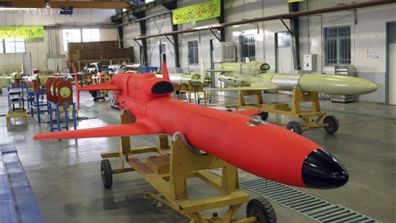
     Moving on we come to Iran's "Ambassador of Death" which is a V-1 flying bomb with a range of 1,000 kilometers, a max speed of 560 MPH, and can be armed with 2 113.4 kilogram bombs or a single 450lbs bomb.
     Stephen Trimble spotted this gem apparently showing a model of a stealth fighter, which looks somewhat like a YF-23.
     While most of this stuff is extremely low tech, if deployed en masse it could drive the price of oil sky high, and shut down the Strait of Hormuz 


Photo Credits (top to bottom): U.S Air Force, Federation of American Scientists, CNN, Fox News, The DEW Line


Saturday, July 2, 2011

It's the Weekend! 7/2/2011

     Get a load of this video showing a bunch of aircraft marshallers at various military bases around the world, dancing.


I did not make this.

Wednesday, May 25, 2011

A Face Only It's Mother Could Love, The A-10 Thunderbolt II

The A-10 is probably the ugliest airplane in skies today but, it is arguably the most dangerous aircraft ever built.
     The A-10 began life as a contender in the A-X program competing against the Northrop YA-9  for the job of being the Air Force's tank buster. The YA-10 first flew on May 10, 1972 and on January 18, 1973 was picked by the Air Force for production. Between 1973 and 1984 over 700 A-10s were built and, as of 2008 335 A-10s and OA-10s (The OA-10 is an A-10 used by forward air controllers, there is no difference between the two versions.) were still in service with the Air Force.
     One of the defining characteristics of the A-10 is the A-10's durability. The A-10 is capable of withstanding multiple hits by small to medium caliber weapons without crashing. The A-10's durability culminates in 1200lbs of titanium armor surrounding some flight control systems and the cockpit, the titanium is so strong that it can withstand hits by 23mm ammunition and some places 57mm hits. The photo below is a graphic example of the A-10's durability, that particular A-10 was damaged when flying over Baghdad in 2003.
       However, the thing that sets the A-10 apart from most ground attack aircraft is it's massive ordnance payload and cannon.The A-10 carries the one of the largest weapons mounted on an aircraft, the GAU-8 Avenger 30mm cannon, the GAU-8 fires a mixture of high explosive round and incendiary rounds and is the ultimate tank busting gun (as the video below shows). The A-10 also can carry up 16,000lbs of ordnance ranging from unguided rocket pods to AGM-65 Maverick missiles. The A-10 has even scored 2 air-to-air kills using it's cannon during the Gulf War, shooting down two Iraqi helicopters.
     The A-10 is not known for it's speed and range like it's more glamorous counterparts, the F-15, F-15E and F-16, with a max speed of around 440 MPH and a combat range of roughly 250 miles depending on the mission. The A-10 may not have a high max speed like the F-16 but, the A-10 has excellent low speed handling especially at low altitude. 
     While the A-10 might have been built in the 1970s for destroying Soviet tanks in Germany the A-10 continues to provide excellent close air support in Afghanistan and previously Iraq and, will continue to do so until 2028 when it will be replaced by the F-35, over 50 years after the A-10's first flight


Photo Credit: U.S. Air Force

Monday, May 16, 2011

China vs. Taiwan Update

Since the Nationalist forces pulled out of mainland China in 1949 the Communist and Nationalist China's have been at each others throats. In the last 15 years this not so friendly rivalry has been intensifying, I have covered some of China's recent actions as seen in "Chengdu J-20: Carrier Killer?", "DF-21D: Is It a Threat?" and "Chinese Naval Aviation Update" with all the coverage going to the "People's" (read communist) Republic of China, I have yet to cover any of the Republic of China's (Taiwan) recent moves.
     In the past few months Taiwan's president Ma Ying-Jeou has urged the U.S. to allow Taiwan to purchase more F-16C/D Block 50/52 Falcons and to allow upgrades to Taiwan's existing F-16A/B Block 20 fleet. President Ma says that these purchases would allow Taiwan to negotiate with the PRC on an equal footing. One of the reasons used to explain the delay in this purchase is that the PRC would retaliate economically if we did so (they hold 1+ trillion dollars of our dept courtesy of the politicians in D.C.). At the same time the Taiwanese have built a homegrown fighter that looks like a cross between an F/A-18 and an F-16.
     Moving on to the world of air defense, the Taiwanese held a drill back in January to test the effectiveness of their I-Hawk surface-to-air missile systems but, 5 out of 19 missiles missed (roughly 25%). Because so many missiles were off target there is speculation that the test will score Taiwan some new American-made surface-to-air missiles, like more MIM-104 Patriot batteries, maybe some MEADS units if and/or when the U.S. reenters the program.
     China in the last 10 years has been rapidly expanding it's navy from a coastal defense fleet to a true blue water navy capable of competing with the U.S. and other countries on the high seas. To answer this threat Taiwan recently fielded the Hsiung Feng III or Brave Wind anti-ship missile on it's warships and, possibly on mobile land launchers as well. The Hsiung Feng III is reported to have a range of 300km, enough to reach mainland China and, a warhead which is rumored to be in the 225kg range. On top of this Taiwan has said that it plans to build a "stealth" warship that will be armed with 8 Hsiung Feng III missiles and 8 Hsiung Feng II missiles. On top of this Taiwan in the last 6 months has added at least 2 frigates and 10 new missile boats to it's naval forces.
     Last, but by no means least is the news that Taiwan has developed an Intermediate Range Ballistic Missile capable of reaching Beijing. Taiwan has not said if the IRBM is nuclear capable though it probably is not nuclear capable and more likely is meant as a deterrent to show the PRC that Taiwan can hurt them. 
     With the ROC (Taiwan) and the PRC (mainland China) both rapidly building up their military's it is almost inevitable that in the next 20 years there will be a clash between the two nations. When this war begins it is almost certain the U.S. will pulled into the war and will at some point lose an aircraft carrier and multiple surface ships. In the present situation there is no real solution that will appease both sides, in this situation there is only one path to take if you wish to remain free, deterrence. Taiwan has up to this point denied having any nuclear, biological or chemical weapons while the PRC has all of these weapons in large quantities and the necessary delivery systems for these weapons. Taiwan must either engage in a massive build up of it's conventional forces or begin a clandestine nuclear weapons program similar to the early Israeli nuclear program. Whatever the ROC does it must do quickly because the U.S. is moving farther and farther away from Taiwan and more and more towards the PRC and will soon not support Taiwan as we have in previous decades.   


Photo Credit: CIA

Wednesday, April 27, 2011

Chinese Naval Aviation Update

    Well, folks I have it to give the ChiComms, they sure know how to deal with labor unions. Defense News reports that the head of the Taiwanese spy agency, Tsai Teh-sheng claims that the Chinese carrier Varyag will be operational by the end of this year. This a very disturbing development for every nation around the Pacific rim because prior to this Chinese air power was limited to the immediate area, now the Chinese will have the ability to project air power throughout the Pacific Ocean. 
     Tsai Teh-sheng claims are further supported by the fact the China's copy of the Su-33 has just been revealed. This new fighter has received the designation J-15 "Flying Shark" and, is probably going to constitute the core of the Varyag's air wing. Not much about the J-15 is known at the moment except, that it probably has the usual equipment used by carrier aircraft, strengthened  landing gear, longer range and possibly better engines. The possibility that the J-15 has better engines than a normal Su-27 as the Su-33 is the carrier version, is highly unlikely because the Chinese have had trouble producing a good indigenous engine for use in fighter aircraft, usually opting to purchase engines from the Russians and copy them either under license or illegally. 
     While the J-15 is a step forward for the Chinese military, the J-15 is not likely to be able to compare with the Super Hornet now in service in the U.S. Navy due to fact that Chinese pilots have had no real air-to-air combat experience since the confrontation with Taiwan in the Second Taiwan Straight Crisis in 1958. Aviation Week also reports that the J-15 is comparable with a F/A-18C which is now being replaced by the F/A-18E/F Super Hornet.
     All in all the J-15 is a step forward for the Chinese but, if push comes to shove between the U.S. and China, I don't believe the J-15 or the surface forces of the Chinese Navy are going to be a serious threat. However, as I said the Chinese surface forces won't be a "serious" threat but, they will be a threat worth keeping an eye on. 


Photo Credits (from top to bottom): Military-Today.com, Defense Tech,

Wednesday, April 20, 2011

No! It can't be true!

DoD Buzz reports that the Air Force is going to slim the B-1 Lancer force down by 6 aircraft to a total of 60 B-1s in service. 
     The reason the Air Force says it is cutting the B-1 is to save 357 million dollars over the next 5 years. What I personally am wondering is, with the ability to pulverize terrorists that the B-1 has shown, why is the B-1 force being cut? As anyone who has any knowledge of current events has seen the increasing tensions between China and the U.S., why would an excellent long range bomber like the B-1 with a range of almost 7,500 miles be cut at a time when it is needed in both the Pacific and Afghanistan? The Air Force in my opinion is being extremely shortsighted in slimming down the strategic bomber force from it's Cold War high down to just, 85 B-52s, 20 B-2s and 66 B-1Bs. 


Photo Credit: Ellsworth AFB