Showing posts with label Nazi Germany. Show all posts

Friday, January 17, 2014

Flashback Friday: Junkers Ju 390

     The Junker Ju 390, a development of the Ju 290 with an extreme range and the ability to carry a meaningful payload over that range. One of the aircraft designed from the Amerika bomber project, it was meant to have three different variants. One each for heavy transport, maritime patrol, and a heavy bomber.
     Specifications from the Luftwaffe Resource Center:

Type: Long Range Bomber or Reconnaissance aircraft.
Origin: Junkers Flugzeug und Motorenwerke AG
Models: V1 to V3 and A-1
Crew: N/A
First Flight: Prototypes only
Final Delivery: None
Number Produced: V1 and V2 Only

Engine:
Model: BMW 801E
Type: 18-Cylinder two-row radial

Dimensions:
Wing span: 165 ft. 1 in. (50.30m)
Length: 112 ft. 2.5 in. (34.20m)
Height: 22 ft. 7 in. (6.89m)

Weights:
Empty: 81,350 lb. (36,900 kg)
Loaded: 166,448 lb. (75,500 kg)


Performance:
Maximum Speed:
    Clean: 314 mph (505 kph)
    Max. Ext. Load: 267 mph (430 kph)
Service Ceiling (Typical): N/A
Range in Recce configuration:
    6,027 miles (9700 km)
Endurance in Recce configuration:
  32 Hours
Payload:
Transport (V1): 22,046 lb. (10,000 kg)
Bomber (V3): 3,968 lb. (1800 kg)

     Just looking at the specification of the Ju 390 it is an excellent reconnaissance/patrol aircraft. Extremely long legs, and a relatively high top speed. Like many German bomber aircraft/designs the payload is somewhat lacking compared to Allied aircraft, but it has a vastly improved range compared to other German bombers (to give Germany her due, she never really had any heavy bombers only medium bombers like the He 111, as there was no really focus in that area by the German high command).
     The Ju 390 did not make into operational service by the end of WWII in Europe. The first prototype aircraft (of which 26 production aircraft were ordered) was completed on 20 October 1943 and took part in tests (including inflight refueling) until March 1944. A second aircraft (Ju 390V2) was completed sometime in 1943 with the first flight taking place in october 1943, with testing continuing until sometime in February 1945.
      The Ju 390 has in recent years become the subject of a rumor stating that a Ju 390 flew from France to within 20km of New York City. This is the subject of some debate, as there is some evidence (Ultra intercepts, and POW interrogations) to indicate such a flight did take place. However, what this rumor does not take into account is any radar system covering the approaches to NYC would have spotted it. NYC was then a hub of shipping, manufacturing, and had many major war contractors in the area. While it would be theoretically possible for A Ju 390 to make such a round trip, it would have to be modified to carry ~50% more fuel and would have been unable to carry any meaningful payload. There are also rumors a Ju 390 carried a Japanese general back to Japan via a polar route, and that a Ju 390 made several transport flights to Argentina before the war ended.
      The Ju 390 is an interesting aircraft as one of the few really long range aircraft produced at any level by Germany. It's planned use, bombing the U.S., thankfully was never used, but from a purely aeronautical standpoint the Ju 390 was an excellent aircraft.


Monday, December 30, 2013

Scharnhorst and Gneisenau: Germany's Last Battlecruisers

     The Scharnhorst-class was a class of battleships or battlecruisers, depending on one's definition, produced by Nazi Germany during the 1930s immediately before WWII. They were meant to serve as a counter to the French Dunkerque-class which was being be built around that time. Built to fight in the North Sea, their armament was limited by the political need not to anger Britain or France. The Treaty of Versailles in 1919 banned Germany from building new battleships, but allowed "armored vessels". However, the Anglo-German Naval Agreement (AGNA) allowed Germany 35% of the total tonnage of the Royal Navy, and new battleships or battlecruisers. This agreement would pave the way for the construction of the Bismarck-class and the H-class.
     Three days before the signing of the AGNA on 15 June 1935, the keel of the Scharnhorst was laid down in Wilhelmshaven. One month before the keel for the Gneisenau was laid down in Kiel on 16 May. The designs for these ships had been completed long before, with an armament of 9 28cm/54.5 SK C/34 guns in three triple turrets (one the few German ship classes to be equipped with tripe turrets) being selected. Armor consisted of a vertical 350mm belt tapering off to 170mm at the outboard slope of the armor deck, and deck armor ranging from 50mm to 105mm. The secondary armament consisted of 12 15cm/55 SK C/28 guns mounted in 4 twin and 4 single turrets (these are not be confused with the 150mm AA guns the Scharnhorst-class carried). The armor on the 28cm turrets was 360mm on the face, 200mm on the sides, 150mm on the roof, and a range of 350mm to 200mm on the barbettes*. Displacement was 37,100 tons. One interesting point about their armor is that generally on battleships, the armor corresponded to the main battery (e.g. guns of 406mm, armor of a thickness that would defeat a 406mm shell). This was not the case with the Scharnhorst-class which carried far more than necessary to defeat an 283mm shell.
     The Scharnhorst and Gneisenau were considered by the Kriegsmarine to be battleships, but were viewed by the Royal Navy as battlecruisers. Their armor listed above compares very favorably to Britain largest battlecruiser, the HMS Hood. The Hood had a 305mm belt (the belt on the Hood was angled at 12 degrees, whereas the Scharnhorst-class had vertical belts), which tapered off to 127mm and 152mm at the ends of the ship. Turret armor on the Hood was slightly heavier than the Scharnhorst-class, the face of the Hood's turrets was 373mm, 299 to 274mm on the sides, and 124mm on the roof. 
     The Scharnhorst and Gneisenau were built for combat in the North Sea against French battleships which is why they carried battlecruiser thickness armor. The 28cm guns were selected for their high rate of fire and the fact that the Dunkerque-class was thought to mostly lightly armored. However, when faced with vessels with a greater armament and armor the Scharnhorst and Gneisenau were unable to return any meaningful damage.
     The operational history is the Scharnhorst-class is excellent with both ships serving well throughout their service lives. During the Invasion of Norway the Scharnhorst and Gneisenau sank the carrier HMS Glorious and two escorting destroyers. During this engagement the Scharnhorst was hit by one torpedo launched by one escorting destroyers which did serious damage to propulsion and flooded four watertight compartments. From the sinking of the Glorious for about six month the Scharnhorst and Gneisenau were inactive while the Scharnhorst underwent repairs. In January of 1941 both ships sortied from Kiel to attack British convoys. They escaped detection and came upon the convoy HX 106 which was escorted by the HMS Ramilles, causing the Scharnhorst and Gneisenau to break off their attack. The ships returned to Brest where, after undergoing repairs, participated in the infamous Channel Dash in February 1941.  Both the Scharnhorst and Gneisenau sustained mine damage off Holland during the Channel Dash and were forced to undergo repairs in Kiel. From February 1941 to March 1941 the Scharnhorst and Gneisenau would remain in German waters. In March 1943 the Scharnhorst was deployed to Norway where she was to link up with the Tirpitz and attack convoys sailing to Russia. The Gneisenau was also supposed to sail with her, but took heavy bomb damage from RAF bombers in late February 1942, and was slated to be reconstructed. This reconstruction would have included an upgrade to her armament with 6 380mm guns similar to those carried on the Bismarck-class. From here the ships separated. 
     The Scharnhorst arrived in Norway on March 22nd. From April 1943 to September 1943 the Scharnhorst and Tirpitz were inactive due to a fuel shortage. Then on September 8th the Scharnhorst and Tirpitz sortied to Spitzbergen where they bombarded shore installations. On December 22nd the Scharnhorst sortied for her final mission (the Tirpitz did not sail with her because she had been damaged by British midget submarines soon after the Spitzbergen operation) to attack convoy JW 55B. 
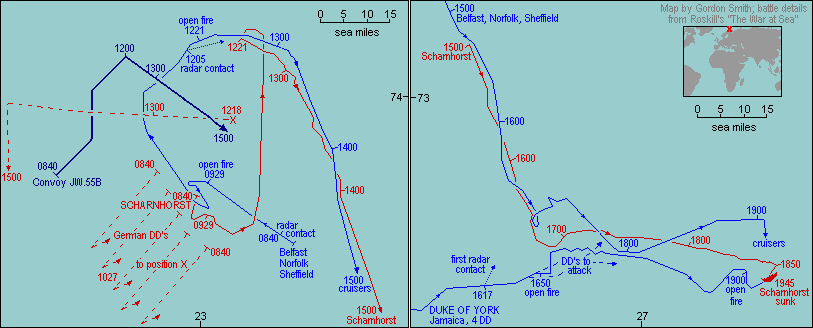
     Convoy JW 55B was escorted by three British cruisers, the light cruisers Sheffield and Belfast as well as the heavy cruiser Norfolk (these were known as Force 1). The King George V-class battleship Duke of York was also in the area providing overwatch for JW 55B and another convoy, RA 55A. The Scharnhorst was unable to make contact with JW 55B, but did find the three escorting cruisers. Force 1 detected the Scharnhorst at a range of 33,000 meters from Force 1, 60,000 meters from the convoy. The Scharnhorst was unaware of the British presence since her radar was off to avoid detection. The British opened fire at a range of 8,600 with star shells to illuminate the Scharnhorst at 0840 on December 26th. During this encounter (from 0925 to 0955) the Scharnhorst sustained two 203mm hits, one of which destroyed the forward rangefinders and crippled the Scharhorst's radar capability (the shell sheared off the radar antenna and killed all personnel in the radar receiving room). The Scharnhorst was now blind in the forward sector, as the aft radar had a limited sweep over the forward sector. At 0955 the Scharnhorst was able to break away from Force 1 and escape. 
"The sinking of Scharnhorst"
     At 1200 the Belfast was able to reestablish radar contact with the Scharnhorst. From this point till about 1315 the Scharnhorst fought with Force 1, scoring a serious hit on the Norfolk around 1223. Around 1315  broke contact and made for Norway. However, in making for Norway the Scharnhorst had to cross the course of the Duke of York. At 1617 the Duke of York made radar contact with the Scharnhorst at a range of 42,500 meters. At 1650 the Duke of York opened fire on the Scharnhorst after she had been illuminated by star shells from the Belfast.  
Map of the Battle of North Cape (click to enlarge)
     This began the last surface engagement of German and British capital ships of WWII. The duel that began was highly unequal because the Scharnhorst 283mm guns simply could not penetrate the Duke of York's armor at any point. The Scharnhorst was able to  damage the Duke of York's superstructure, and temporarily knock out her fire control radar. However, between 1650 and 1842, when the Duke of York ceased firing, the Scharnhorst took at least 13 356mm hits. At the end of the gunnery duel the Scharnhorst was still making around 22 knots, leading to a British torpedo attack around 1850. 4 torpedoes hit, slowing the Scharnhorst to 12 knots, though the chief engineer reported he could still produce 22 knots. At this point a second torpedo attack was made because of the apparent inability to sink German capital ships by gunfire (this was learned from inability to sink the Bismarck by gunfire). At 1900 all confidential papers were burned by order of the Scharnhorst's captain. At 1945 the Scharnhorst sank bow first with her propellers still turning. Out of a crew of 1968 officers and enlisted man, only 36 enlisted men survived the engagement. Thus, ended the Battle of North Cape.
     As to the fate of the Gneisenau, work was eventually stopped in early 1943 at the order of Hitler, who was angry at the failure of German surface raiders. The 283mm turrets that had been removed to make way for the new 380mm turrets, were shipped to Norway. There they were installed as coastal defense guns, where one remains there to this day. From 1943 to till 1945 nothing happened to the remains of the Gneisenau. In March 1945 the Gneisenau was towed into the entrance of the harbor of Gotenahfen where she was sunk as a block ship to delay the Advance of the Red Army. Her hull was scraped by the Polish government from 1947 to 1951.
        The Scharnhorst-class was never able to fulfill it's mission of fighting in the French or British in the North Sea. They were forced into a commerce raiding role which they were not optimized for, and when faced with superior opponents were unable to deal damage back. Their armor was excellent for their displacement, but they did not have the survivability of German WWI battlecruisers. Germany packed a lot of punch into relatively small hulls, an they would have performed well in a hypothetical North Sea engagement. However, when forced into a commerce raiding role or engaging more heavily armored ships, they simply could not do the job.


* All turret armor numbers are taken from Naval Weapons of World War Two by John Campbell.


Friday, December 27, 2013

Flashback Friday: O-class Battlecruisers

     Part of Plan Z was the construction of three O-class battlecruisers. The design originated from a proposal to increase the armament of the proposed P-class to 380mm guns.The O-class was designed for commerce raiding and their specifications show this. By mid-1939 all work on the P-class had stopped and was redirected into the O-class. 
     O-class specifications*:
Displacement                       31,142 tons
Full load displacement          35,367 tons
Waterline length                    246.0m
Waterline beam                     30.0m
Draft (design)                        8.0m
Draft (full load)                      8.8m
Armament                              six 38cm/52 SK C/34 paired
                                             six 15cm/48 Tbts KC/36T paired 
                                             eight 10.5cm/65 SK C/33 paired (AA)
                                             eight 3.7cm/L83 SK C/30 paired (AA)
                                             twenty 2cm/65 C/30 in five quads (AA)
                                             twelve 533mm torpedo tupes in four fixed triple mounts
                                             four Arado-196 floatplanes
         
Speed                                  33.5 knots at designed displacement
Shaft horsepower                 176,000
Endurance                           14,000 nautical miles at 19 knots
Protection                            90mm upper belt
                                            190mm  main side belt
                                            30 mm upper deck
                                            60mm armor deck
     Let's start with protection. In comparison to the numbers listed above for the O-class, the HMS Hood had a a side belt of 203mm, a 127mm upper belt, an upper deck of 32mm, and a lower deck of 48mm. The O-class had lighter armor than the Hood. On 24 May 1941 the Hood was sunk by a single hit from the Bismarck which penetrated to her magazines, which detonated. The loss of the Hood directly confirmed the insanity of lightly armored capital ships engaging hostile capitals ships. The protection scheme of the O-class was obsolete the second it was designed. The lack of armor may have saved weight, leading to a greater speed, but the cost in staying power was tremendous. For further examples of lightly armored battlecruisers being lost to magazine explosions, look no further than the Indefatigable, Queen Mary and Invincible. All lost to magazine explosions at Jutland. The O-class would have been dead the moment it engaged a battleship.
The explosion of the Queen Mary at Jutland
     Moving on to the armament, this is a spot where the O-class wasn't as bad. The O-class was armed with 6 38cm guns. Though while this armament would have been excellent for sinking merchant vessels, in an engagement with hostile battleships the O-class would have been heavily outgunned. However, the O-class had the advantage in speed over almost every class of battleship that served in WWII (the Iowa-class being the exception). Assuming a hostile battlecrusier had been able to catch an O-class, the gunnery duel would have been almost equal. For comparison the Repulse-class battlecruisers carried six BL 15in MK 1 guns, and the French battleship Dunkerque carried 8 330mm guns. As to the secondary anti-aircraft armament, the O-class would have had very light defenses against air attacks. Only 36 guns of varying calibers. This was light even for German vessels. The Bismarck carried 16 10.5cm AA guns, 16 3.7cm guns, and 20 2cm guns in comparison. 
The Tirpitz firing her main battery
     The power plant for the O-class were eight 24 cylinder MAN diesel engines (V type), arranged four to a shaft. The diesels generated 13750 horsepower each continuously, and had a maximum rating of 15000 horsepower each. The centerline shaft (the O-class would have had three propellers) was driven by a steam turbine and four high temperature and pressure boilers. The operating temperature for the boilers would have been 460 degrees celsius (and could be superheated to 960 degrees celsius), and the operating pressure would have been 55kg per square cm. The steam plant was rated at 55,000 horsepower normally, and 60,000 at maximum. The use of mixture of diesel-steam powerplant allowed a relatively low fuel consumption rate, and an endurance of 14,000nm to 15,000nm at 19 knots. Though, this range would only have been attained with only the diesels in operation. 
     The method in which these ships were to be used, was commerce raiding. It was planned that a task force made up of 3 H-class battleships, an aircraft carrier, with cruisers and destroyer as escorts, would engage convoy escorts. Allowing the battlecruisers to strike the undefended merchant vessels. How this proposed task force would break out of the North Sea, or the English Channel has not been shown. Had such a force attempted a breakout, the British would have undoubtedly sortied the Home Fleet to engage the force. Any O-class vessel attached would have almost assuredly been lost in an such an engagement. It must be remembered that the British were able to keep the Geramn High Seas Fleet bottled up in the North Sea for the duration of WWI. The location of Germany would have precluded the effective use of an O-class battlecruiser as a commerce raider simply because of the gauntlet that would have had to be run to reach the British convoys.
     The O-class is an interesting mental exercise, in what a Bismarck with no armor would look like. However, in combat the glaring lack of armor would have doomed them to penetrating hits to magazine and machinery spaces. The armament was passable, but lacking in the AA role. The mission that was planned for the O-class was, while feasible, do not take into account the location of Germany or the possibility of an encounter with better armored and/or armed opposition. The O-class as designed was a floating coffin, nothing more, nothing less.


*Garzke, William and Dulin, Robert. Battleships: Axis and Neutral Battleships in WWII.
Painting at top by Richard Allison.


Friday, December 20, 2013

Flashback Friday: Plan Z

     This week's Flashback Friday is an overview of Nazi Germany's Plan Z. In January of 1939 Adolf Hitler ordered a build up of the Kriegsmarine, which by 1945 would have looked something like this:
  • 2 Aircraft Carriers
  • 10 Battleships (Six H-class,  2 Bismarck-class, and 2 Scharnhorst-class)
  • 3 O-class battlecruisers
  • 12 P-class Panzerschiffe (pocket battleships)
  • 3 Deutschland-class Panzerschiffe
  • 5 Heavy cruisers
  • 36 M-class light cruisers
  • 24 Spahkreuzer (large destroyers or reconnaissance cruisers)
  • 68 Destroyers
  • 90 Torpedo boats
  • 249 U-boats
     A few things stand out from this plan. First, the emphasis is on surface ships which fits with Hitler's intent on challenging the Royal Navy. Second, too few destroyers are planned compared to the number of cruisers and battleships. Only two destroyers for every BB and cruiser, in comparison the U.S. had about four destroyers for every BB or cruiser. Third, few U-boats. Plan Z did not plan for the massive U-boat campaign in the Atlantic, and the planned U-boat numbers show this. Finally, there is a distant emphasis on surface commerce raiding in the form of the 12 P-class pocket battleships in addition to the 3 Duetschland-class vessels.  
     Plan Z had the sole mission of giving Nazi Germany the ability to challenge the Royal Navy for control of the North Sea, the North Atlantic and nearby waters. Had the plan the plan been completed it would have easily broken local Royal Navy control*. However, had the two fleets met in battle a la Jutland the outcome is debatable. The Royal Navy would have had all the KGVs, Lion-class, and the Vanguard. 12 new BBs in addition to the Hood, Nelson, Rodney, and 12 other WWI-era BBs. 27 battleships, of which 14 of which were modern, against 10 modern German BBs of varying capabilities (the Scharnhorst-class was more of a battlecruiser design). This also leaves out the question of escorts and the influence of naval air power which was instrumental in the Pacific and in sinking the Bismarck.
     In the end Plan Z was another Nazi pipe dream because of the titanic economic costs and British naval and shipbuilding superiority. It provides fodder for what-if scenarios today, but was of little practical value in WWII.


*Clarification, the German Navy would have been able to break out of the North Sea and Bay of Biscay (assuming France would have fallen if the war had started in 1945) with relative impunity.


Friday, July 12, 2013

Flashback Fridays: H-Series Battleships

     This week's Flashback Friday focuses on Nazi Germany's H-series battleships. The H-series was a series of battleship proposals put forth by the Third Reich for Plan Z. Of 5 H-series proposals, only one class made it to construction, the H-39. The other classes were the H-41, H-42, H-43 and the titanic H-44. Plan Z called for six H-39 battleships, of which construction began on two, the other four never made it to construction. Both H-39s were scrapped in November 1941. It would take several paragraphs to explain the specifications on all five H-series proposals, so below is a table of specs from German Warships: 1815-1945:
DesignH-39H-41H-42H-43H-44
Displacement56,444 t (55,553 long tons)68,800 t (67,700 long tons)90,000 t (89,000 long tons)111,000 t (109,000 long tons)131,000 t (129,000 long tons)
Length277.8 m (911 ft 5 in)282 m (925 ft 2 in)305 m (1,000 ft 8 in)330 m (1,082 ft 8 in)345 m (1,131 ft 11 in)
Beam37 m (121 ft 5 in)39 m (127 ft 11 in)42.8 m (140 ft 5 in)48 m (157 ft 6 in)51.5 m (169 ft 0 in)
Draft10 m (32 ft 10 in)11.1 m (36 ft 5 in)11.8 m (38 ft 9 in)12 m (39 ft 4 in)12.7 m (41 ft 8 in)
Main8 × 40.6 cm (16.0 in)8 × 42 cm (17 in)8 × 48 cm (19 in)8 × 48 cm (19 in)8 × 50.8 cm (20.0 in)
Secondary12 × 15 cm (5.9 in)
and 16 × 10.5 cm (4.1 in)
12 × 15 cm (5.9 in)
and 16 × 10.5 cm (4.1 in)
12 × 15 cm (5.9 in)
and 16 × 10.5 cm (4.1 in)
12 × 15 cm (5.9 in)
and 16 × 10.5 cm (4.1 in)
12 × 15 cm (5.9 in)
and 16 × 10.5 cm (4.1 in)
AA16 × 3.7 cm (1.5 in)
and 12 × 2 cm (0.79 in)
32 × 3.7 cm (1.5 in)
and 12 × 2 cm (0.79 in)
28 × 3.7 cm (1.5 in)
and 40 × 2 cm (0.79 in)
28 × 3.7 cm (1.5 in)
and 40 × 2 cm (0.79 in)
28 × 3.7 cm (1.5 in)
and 40 × 2 cm (0.79 in)
Torpedoes6 × 53.3 cm (21.0 in)6 × 53.3 cm (21.0 in)6 × 53.3 cm (21.0 in)6 × 53.3 cm (21.0 in)6 × 53.3 cm (21.0 in)
      Several things stand out from the specs of the H-series, as the war went on (the H-41 through H-44 were designed from 1940-1942) AA armament increased in the designs, as evidenced by the increasing numbers of 37mm and 20mm cannons. The draft of the H-series also increased, to the point where the H-42, H-43, and H-44 would have been unable to use any German port without being dredged. Also, the main armament of the H-44 would have been 8 508mm guns which would have been the largest naval guns ever put to sea, larger than even Japan's Type 94 gun. It's also probable that the torpedo tubes would have been removed by the time any H-series battleship made it to construction.
       The H-39 was expected to fight at relatively close ranges, and as such was designed with vertical side belt armor, the upper side belt being 145mm, the lower side belt 220mm thick. It was calculated* that an H-39 would have been immune to a 16"/45 shell from 11km to 21km on the lower side belt, though a 16'/45 shell would have been able to penetrate the upper side belt at any distance. Deck armor ranged from 50mm-150mm depending on the area, magazines having the thickest deck armor, and machinery spaces having the thinnest armor. Turret armor ranged from 130mm-385mm thick, barbette armor ranged from 365mm to 240mm thick, with armor on the secondary battery being significantly thinner. The H-41 had increased armor on the deck, otherwise the armor scheme was the same as the H-39. Armor specs on the H-42 through H-44 are unavailable, but it would stand to reason that all three would have drastically increased armor in every area. 
      To get an idea of the size of the H-39 here is a photo where an depiction of an H-39 is superimposed next to the Tirpitz.
     The H-series battleships were for the most part hypothetical designs with the H-39 and H-41 being the most practical designs of the series. The designs after that, the H-42, -43, and -44, were all no more than mental exercises because by the time the designs were finished Germany was not in position to build anything larger than a destroyer for the duration of the war. In fact designs made after the H-41 were ordered by Hitler, and that can be seen in their massive size and armament. The H-39 and H-41 can be compared to the Montana-class in that they were practical designs, but the role they were meant to fulfill (slugging matches against other battleships) was taken over by aircraft and the materials slated for use in construction were diverted to more urgent needs. As to the H-42, -42, -44, they were no more than mental exercises along with the fact that they were huge, cumbersome, and impossible to build, similar to the Tillman Battleships.    

Photo Credit: Richard Allison
*Garzke, William H.; Dulin, Robert O. (1985). Battleships: Axis and Neutral Battleships in World War II. Annapolis: Naval Institute Press.

Friday, May 25, 2012

Flashback Friday: Heinkel He 219 Uhu

     This week we take a look at one the world's first and best night-fighters, the Heinkel He 219 Uhu (Eagle-Owl). Among other innovations, the Eagle-Owl was equipped with an ejection seat, and a VHF intercept radar.
      Less than 300 Eagle-Owls were built during World War II, but for such a small production run it had a great effect on the RAF's night bombing campaign. During the Eagle-Owl's combat debut, a single Eagle-Owl shot down 5 RAF fighters. The Eagle-Owl was also one of the only German aircraft that could fight a British Mosquito on even terms, due it's peed, maneuverability, and firepower.
    However, due to the fact that all of Germany's resources were being poured into the "Emergency Fighter Program", only ~300 He 219s were built. As of 2012 2 He 219s survive, one in National Air & Space Museum, and one in Denmark. The He 219 was such a promising design, one has to wonder how it would have affect the RAF's night-bombing campaign if more resources had been invested in it.


Photo Credit: LuftwaffePhotos

Friday, May 18, 2012

Flashback Friday: Dornier Do 335

     This is the first of hopefully many Flashback Fridays, and this week the subject is the Dornier Do 335 "Arrow". The Do 335 was a propeller-driven fighter developed in the closing weeks of WWII. What makes the Do 335 standout from so many WWII fighters is it's push-pull engine configuration, and the lower drag of the in-line engine alignment.
      The Arrow had an armament of 1 30mm cannon and 2 20mm cannons, and could carry 1000kg of bombs. The Arrow had a range of roughly 1400km, and a max speed of 770kmh.  The Arrow was powered by 2 Diamler-Benz liquid-cooled, 12 cylinder in-line engines generating 1,750 horsepower apiece.
      The Arrow was unable to be deployed in large numbers due to delays in engine deliveries, and the fact that the U.S. overran the factory were it was being produced. However, eleven Arrows were delivered to the Luftwaffe, with at least one seeing combat. French ace Pierre Clostermann encountered a single Arrow on a fighter sweep while flying a Hawker Tempest in April of 1945. When he and his flight of 4 other Tempests pursued the Arrow it was able it outrun them, and escape. Besides this one encounter, there are no there confirmed instances of the Do 335 seeing combat.
     The Do 335 had a great deal of potential with it's ability to outrun most allied fighters, and had it been mass produced a year earlier it could have changed the course of the war. However, due to delays and the lack of resources it was unable to see a great of combat. As of 2012 one Do 335 survives, it resides at the National Air & Space Musuem. With so many promising projects being developed in Germany at the end of WWII, one wonders how long the war would have dragged on if Hitler had started WWII in 1946 like he had planned.


Photo Credit: Wikipedia