Showing posts with label Destroyers. Show all posts

Friday, January 3, 2014

Flashback Friday: Fubuki-class Destroyers

     This week's Flashback Friday look at Japan's Fubuki-class destroyers. Said to be the first "modern" destroyer, the Fubuki-class featured power-driven and weatherproof twin 5" mounts and torpedo reloads. Built starting in 1928 they remained part of Japan's front line fleet through the end of World War Two. 
Displacement (standard):    1750 tons
Displacement (rebuilt):       2050 tons
Length:                               118.4m
Beam:                                 10.4m
Draft:                                  3.2m
Propulsion:                         2 geared turbines driven by 4 boilers
Speed:                                38 knots
Range:                                5,000nm at 14 knots 
Crew:                                 219                            
Armament:                         six 12.7cm/50 3rd Year Type guns (paired)
                                           two 13mm/76 Type 93 MG
                                           nine 533mm torpedo tubes (three triple mounts)
                                           eighteen torpedoes
     The Fubukis were unique for their time as they had enclosed turrets for their 12.7cm guns. Most destroyer classes of the Interwar Period had open turrets. The rear of the turret was open to facilitate reloading and maintenance. However, the Fubukis had fully enclosed turrets which allowed use in all weather conditions. At the same time the Fubukis were the first destroyer class to carry reloads for their torpedo tubes. However, the Fubukis were rebuilt in the 30s due to longitudinal strength issues which were discovered after a typhoon damaged most of the Japanese Fourth Fleet. During this reconstruction the Fubukis lost their torpedo reloads.
      Beyond their armament there were not many other major innovations in the Fubuki-class destroyers.
The Fubukis were larger than most contemporary destroyers, with a 500 ton advantage in displacement over the U.S. Clemson-class destroyers. They were also faster than the Clemsons, by a full 2.5 knots. They were longer, wider, and had a deeper draft than the Clemson-class or the British A-class. 
      The Fubukis served from 1928 through 1945 in the service of the Japanese Navy. After World War II one Fubuki, the Hibiki, was turned over to the USSR as a war prize, and served until 1953. Of 24 Fubukis built, all but two were lost. Eight were sunk by submarines, two by mines, at least one by scuttling, and the remainder by air attacks. For vessels built in the late 1920s the Fubukis remained surprisingly potent through WWII. Interestingly, it was a Fubuki-class destroyer, the Amagiri, that rammed and sank PT-109 commanded by John F. Kennedy. 
     The Fubukis carried an armament that for their time punched far above their weight. They allowed greater flexibility in their use because of their heavy armament and high speed. For this, the Fubukis have earned a place in naval history.
     

Wednesday, July 10, 2013

Russian Navy To Receive 24 Submarines By 2020


ST. PETERSBURG, July 7 (RIA Novosti) – The Russian Navy will receive 36 warships in 2013, an unprecedented number in Russia’s history, Navy Deputy Commander-in-Chief, Vice Admiral Alexander Fedotenkov said on Sunday.
“During this year, 36 combat ships, fast attack crafts and support vessels will join the Russian Navy. This has never happened before,” Fedotenkov said at the International Maritime Defense Show in St. Petersburg.
Russian Navy warships are now performing missions in all areas of the World Ocean, with over 60 combat ships currently at sea, he said.
Defense Minister Sergei Shoigu said in March the Russian Navy would receive 24 submarines and 54 warships of various classes by 2020.
“As a result of the implementation of the state rearmament program to 2020, the navy should receive eight nuclear-powered strategic submarines, 16 multirole submarines and 54 warships of various classes,” Shoigu said.
The eight strategic missile boats include three Borey and five Borey-A class vessels (SSBN) armed with Bulava ballistic missiles.
The 16 multi-purpose submarines include eight Graney class nuclear-powered attack submarines (SSN) and improved Kilo and Lada class diesel-electric (SSK) boats.
In addition to submarines, the navy will receive Admiral Gorshkov class frigates and Steregushchy class corvettes, Buyan class corvettes and Ivan Gren Class large landing ships.
Russian President Vladimir Putin said last year that the procurement of new warships and submarines for the Navy would be a priority over the next decade. The Russian government has allocated five trillion rubles ($166 bln) or a quarter of the entire armament procurement budget until 2020 for this purpose.
     Russia is expanding their navy, but I find it hard to believe that they can build 8 SSNs and 8 SSBNs in seven years. It took four years to build the Severodvinsk, and the Kazan is slated to be launched in 2014, a build time of ~3 years. To build 16 nuclear submarines is possible for the Russians, but a building program like this hasn't been around since the end of the Cold War. 


Monday, July 1, 2013

Analysis of Alternatives: Zumwalt-class DDGs

     In 2011 The Navy began construction of it's latest class of DDGs, the Zumwalt-class. The mission of the Zumwalt-class is shore bombardment and cruise missile attack, with a little bit of AAW thrown in as well. However, the Zumwalt-class does not have sufficient VLS (80 missile cells) space to provide effective AAW while at the same time carrying the number of Tomahawks needed. At the same time Zumwalt-class has concerns about it's seakeeping capabilities  due to it's tumblehome hull design. The Zumwalt-class will also not be built it large numbers, with a production run of only three ships. Leaving the vast majority of the Navy without any high caliber guns for shore bombardment. Here are what I believe are solid alternatives to the Zumwalts.
     1. Modify Burke-class destroyers under construction and DDGs 85-112 to mount a single Mk 71 8"/55 caliber gun on the bow. The Mk 71 was developed back in the 1970s to fill the growing gap in naval gunfire support, as there were few guns in the Navy larger than 5". The Mk 71 offers improved range over a 155mm gun firing the M795 (27km vs 22.5km) and a larger round (118kg v 46.7kg). Off the shelf is a match for any 155mm gun in U.S. inventory firing any type of ammunition (the only acceptation being the LRLAP round).
     I would argue that the Mk 71 is better than the AGS because the AGS has no anti-ship capability, and fires only one round, the LRLAP. With only a small amount of LRLAPs being purchased for only 6  operation guns (3 Zumwalts, 2 guns apiece), the cost per round will be abnormally high. To sum it up, I'd like to quote ComNavOps over at Navy Matters.

  • Cost – when the Navy committed to the AGS the Mk71 development costs were already long since paid for.  The gun was essentially free and a prototype had already been successfully tested.  Advanced rounds, if desired, would have entailed additional costs just as for the AGS.
  • Explosive Power – the 8” round is so much more effective than a 6”.
  • Shipboard Impact – the AGS, as we’ve discussed has a major impact on ship design and ship utilities.  The Mk71 is a simple gun and easily accommodated.
  • Flexibility – the Mk71 is a general purpose gun capable of engaging both ship and shore targets unlike the AGS which has no anti-ship mode.

Since it is almost impossible to cancel the Zumwalts at this point, it would be best to cancel the AGS and LRLAP, and mount Mk 71s in lieu of AGSs on the Zumwalt-class. They will provide the Zumwalt-class with a WVR anti-ship capability and an improved naval gunfire support capability at a lower cost.
     2. New class of AAW and land attack ships built around large numbers VLS cells and the AMDR.  This is basically the Arsenal ship concept, a stretched Tico hull (Long Beach size) with an increased number of VLS cells, a nuclear power plant, and an Air and Missile Defense Radar. Remove the helipad, aviation facilities, 5" guns, torpedo tubes, and ASW suite. This would make room for 8-10 more Mk 41 VLSs, yielding a magazine increase of 481-610 missiles. The sole mission of this ship would be to provide anti-air coverage for carriers, and BMD and land attack support for amphibious assaults. The Zumwalt-class has a smaller VLS capacity than the Ticos (80 vs. 122), and yet it is expected to contribute in AAW while at the same launching TLAMs in support of amphibious assaults. This leads to a compromise and a loss of capability in the area of AAW which will be pivotal in any amphibious assaults.
      I do not believe that the Zumwalt-class is the right choice for the Navy in light of cost overruns and continued delays. Each mission (naval gunfire support, land attack, and AAW) that the Zumwalt-class is meant to perform requires vastly different capabilities, with AAW and land attack requiring large numbers of VLS cells which will deny space to needed guns for naval gunfire support. It would be more effective to build a class of ships meant entirely for missile warfare (AAW and land attack), while modifying existing and future destroyers to carry the Mk 71 to provide more effective naval gunfire support.


Tuesday, July 24, 2012

Russian Task Force En Route To Syria Enters Med

      From Defense News:


MOSCOW — A Russian naval flotilla of warships destined for the Syrian port of Tartus has entered the Mediterranean, Russia’s defense ministry said Tuesday.
“The Russian ships today passed the Strait of Gibraltar and entered the Mediterranean at 1200 GMT,” said a defense ministry spokesman, quoted by Itar-Tass agency.
Led by the Admiral Chabanenko anti-submarine destroyer, the three landing craft left their home port of Severomorsk in the Arctic Circle earlier this month. They are due to be joined in the Mediterranean by the Russian patrol ship Yaroslav Mudry as well as an assistance vessel.
The ships will perform “planned military maneuvers”, said the ministry. Earlier in the month a military source said the ships would be topping up on supplies of fuel, water and foodstuffs.
Russia has denied that the deployment is linked to the escalating conflict in Syria.

     This is at least the second time the Russian Navy has sailed to Syria since the conflict, as the aircraft carrier Admiral Kuznetsov arrieved in Syria in December of 2011. As to why Russia is doing this again, it is probably to deliver arms, and/or evacuate Russians from Syria.


Thursday, September 29, 2011

Iranian Navy To Patrol Off U.S. Coast

     Defense Tech reports that Iran plans to establish a "powerful force" off the U.S. eastern seaboard.
     While this propaganda is probably for internal consumption, if followed through it could pose a threat to states on the Gulf of Mexico. The main problem with this is the range factor, as the eastern seaboard is over 6,000 kilometers from Iran's major naval base at Bandar Abbas. However, Iran does have some friends in the region, Venezuelan dictator Hugo Chavez is a friend of Iran's and would probably offer Iran the ability to refuel at a Venezuelan port. And of course there is always Cuba, which is stilled ruled by the old fool named Fidel Castro, who would also probably offer Iran the ability to refuel at a Cuban port.
     While it is highly unlikely that Iran will mount a naval expedition to the U.S. eastern seaboard, if they do it could pose a threat to the many Oil Rigs in the Gulf of Mexico. Along with the massive fishing fleet that works the Gulf. As this continues to develop it will be interesting to see if Iran actually attempts this. If so, how do you say "live fire exercise" in Farsi?

Thursday, June 9, 2011

China Admits What The West Already Knew: Yes, We Are Building An Aircraft Carrier

Well, its official, Defense News reports that General Chen Bingde (whom I have discussed before) admitted the existence of the Varyag (now known as the Shi Lang) along with the fact that they are overhauling it.
     Personally, I am surprised that China has not admitted the existence of the Varyag prior to yesterday as almost every defense enthusiast knows of the Varyag's existence and overhaul. I have written quite a bit about the Varyag (I can't bring myself to call it the Shi Lang), covering everything from the Varyag's weapon systems to the J-15.
     With the Chinese finally admitting that the Varyag exists, it's interesting to see that the Chinese military is similar to the Soviet military in that they both are and were extremely secretive.


Monday, May 16, 2011

China vs. Taiwan Update

Since the Nationalist forces pulled out of mainland China in 1949 the Communist and Nationalist China's have been at each others throats. In the last 15 years this not so friendly rivalry has been intensifying, I have covered some of China's recent actions as seen in "Chengdu J-20: Carrier Killer?", "DF-21D: Is It a Threat?" and "Chinese Naval Aviation Update" with all the coverage going to the "People's" (read communist) Republic of China, I have yet to cover any of the Republic of China's (Taiwan) recent moves.
     In the past few months Taiwan's president Ma Ying-Jeou has urged the U.S. to allow Taiwan to purchase more F-16C/D Block 50/52 Falcons and to allow upgrades to Taiwan's existing F-16A/B Block 20 fleet. President Ma says that these purchases would allow Taiwan to negotiate with the PRC on an equal footing. One of the reasons used to explain the delay in this purchase is that the PRC would retaliate economically if we did so (they hold 1+ trillion dollars of our dept courtesy of the politicians in D.C.). At the same time the Taiwanese have built a homegrown fighter that looks like a cross between an F/A-18 and an F-16.
     Moving on to the world of air defense, the Taiwanese held a drill back in January to test the effectiveness of their I-Hawk surface-to-air missile systems but, 5 out of 19 missiles missed (roughly 25%). Because so many missiles were off target there is speculation that the test will score Taiwan some new American-made surface-to-air missiles, like more MIM-104 Patriot batteries, maybe some MEADS units if and/or when the U.S. reenters the program.
     China in the last 10 years has been rapidly expanding it's navy from a coastal defense fleet to a true blue water navy capable of competing with the U.S. and other countries on the high seas. To answer this threat Taiwan recently fielded the Hsiung Feng III or Brave Wind anti-ship missile on it's warships and, possibly on mobile land launchers as well. The Hsiung Feng III is reported to have a range of 300km, enough to reach mainland China and, a warhead which is rumored to be in the 225kg range. On top of this Taiwan has said that it plans to build a "stealth" warship that will be armed with 8 Hsiung Feng III missiles and 8 Hsiung Feng II missiles. On top of this Taiwan in the last 6 months has added at least 2 frigates and 10 new missile boats to it's naval forces.
     Last, but by no means least is the news that Taiwan has developed an Intermediate Range Ballistic Missile capable of reaching Beijing. Taiwan has not said if the IRBM is nuclear capable though it probably is not nuclear capable and more likely is meant as a deterrent to show the PRC that Taiwan can hurt them. 
     With the ROC (Taiwan) and the PRC (mainland China) both rapidly building up their military's it is almost inevitable that in the next 20 years there will be a clash between the two nations. When this war begins it is almost certain the U.S. will pulled into the war and will at some point lose an aircraft carrier and multiple surface ships. In the present situation there is no real solution that will appease both sides, in this situation there is only one path to take if you wish to remain free, deterrence. Taiwan has up to this point denied having any nuclear, biological or chemical weapons while the PRC has all of these weapons in large quantities and the necessary delivery systems for these weapons. Taiwan must either engage in a massive build up of it's conventional forces or begin a clandestine nuclear weapons program similar to the early Israeli nuclear program. Whatever the ROC does it must do quickly because the U.S. is moving farther and farther away from Taiwan and more and more towards the PRC and will soon not support Taiwan as we have in previous decades.   


Photo Credit: CIA

Wednesday, May 11, 2011

Royal Navy Commissions Another Type 45

Defense Talk reports that the Royal Navy recently commissioned it's third Type 45 Air Defense Destroyer named the Diamond  in Portsmouth. 
     The Type 45 destroyers are designed to replace the Type 42 guided missile destroyers that were built during the 70s and 80s. The Type 45-class is expected to have a production run of 6 ships of which Daring and Dauntless are active, Diamond and Dragon are undergoing trials and Defender and Duncan are being built. The Type 45 is armed with a SYLVER vertical surface to air missile launcher armed with Aster series missiles, Stingray helicopter launched torpedoes and a 4.5" main gun on the bow. The performance figures for a Type 45 are actually pretty good: max speed: 27 knots, cruising speed: 18 knots, range: 7000 nautical miles at 18 knots.
     As the 6 Type 45s are supposed to replace the 14 Type 42s, it will be interesting to see how the Type 45 fares in naval combat with fewer numbers than in previous decades.


Photo Credit: Brian Burnell

Thursday, April 28, 2011

What Happend To the 600-Ship Navy?

     During the 1980s at the height of the Cold War, Ronald Reagan pushed a massive military modernization and expansion plan that for the Navy would have resulted in a 600-Ship Navy. My question is what happened to that idea?
     When the Soviet Union collapsed in 1991, governments around the world began to make massive budget cuts to their military's, one example is the so called Royal Navy and British Army, both of which are skeletons of their former selves. Since the collapse of the Soviet Union most governments have begun rearming (Britain hasn't) and putting their military's back together. Since 1991 the U.S. has expanded it's military but, the 600-Ship Navy idea is nowhere to be seen. The 600-Ship Navy has become a victim of several groups, socialists/communists who want to redistribute wealth and want a larger government, cost cutters who think now the the USSR is gone we can put the money into other programs, peace groups who think there should be no military at all and the list goes on.
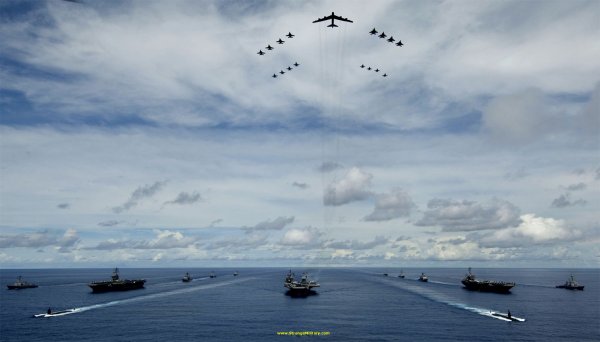
      Few poeple outside the military realize how dire the situation really is, since 1987 the Navy has gone from the 1980s high of 594 ships to about 290 ships in service in 2011. Since 1987 our Navy has been more than halved and almost nobody in the media, the government or the people realizes it. Our Navy has been second to none since the end of WWII when we had over 6,000 ships and still are larger that the next seven navies combined but, China is rabidly increasing the size of their Navy and as of 2011 are second in size to only to the U.S. and climbing.
     The Navy is starting to begin building ships a higher rate in the last couple of years but, as I said a couple of articles ago the Navy is crumbling before our very eyes. And if we do not correct this situation, the cosequences could be extremly bad to say the least.


Photo credit: New Wars