Showing posts with label Air Defense Systems. Show all posts
Showing posts with label Air Defense Systems. Show all posts
Friday, February 15, 2013
Meteor Airburst Over Russia
Today a 7,000 ton meteor blew up over Russia injuring 1000 people. Russia claims to have hit the meteor with ABM defense, but that is unconfirmed and unlikely. Scott Lowther over at The Unwanted Blog ran the numbers and the equivalent nuclear weapon to this meteor would have had a yield of 271kT, about 13 times larger Hiroshima. See some dashcam videos of the event:

Thursday, September 8, 2011
Libyan SA-24s: Terrorists New Toy

The SA-7 was developed in the 1970s to shoot down low flying western aircraft, and has a max altitude 4.5 kilometers (2.8 miles) and a warhead of 1.15 kilogram (2.5lbs). The SA-7 has been fired at civilian airliners several times, including an incident where a DHL aircraft was hit by an SA-7 taking off from Baghdad in 2003.
However, the more serious threat is the SA-24 Grinch. The SA-24 has a maximum engagement altitude of 6 kilometers (3.7 miles), and a warhead of 2.5 kilograms (5.5lbs). The SA-24 also has a more advanced guidance system than the SA-7, and is not as easy to evade as the SA-7. The SA-24 entered into service with the Russian military in 2004 making it rather new, and thus is just entering it's service life. This also makes the SA-24 a threat for a long time to come as the batteries in a MANPADS's (MAn Portable Air Defense System ) guidance system determine the missile's lifespan as long as there are no problems with the missile itself.
As Libya is still in turmoil it will be interesting to see what other weapons are stolen from ex-Qaddafi weapons caches.
Photo Credit: Mike1979Russia
Thursday, August 11, 2011
Taiwan Announces Hsiung Feng III Is For Sinking Chinese Carriers


Defense News reports that Taiwan designed the Hsiung Feng III for attacking aircraft carriers, specifically the ones operated by China.
The painting above was displayed at the Taipei Aerospace and Defense Technology Exhibition showing the Varyag being hit by 3 Hsiung Feng 3 cruise missiles. This extremely unusual for the Taiwanese, as they usually don't explicitly say that China is the enemy. Thus, this drawing is essentially saying that Taiwan is not afraid of China, and that if attacked could inflict serious casulties on the Chinese.
Another interesting aspect of this picture is that in the extreme left there is another ship which looks like an aircraft carrier, due to the fact that the superstructure is amidships, and on the port side, similar to an aircraft carrier. If this is an aircraft carrier, it appears to be of similar size to the Varyag, and possibly of the same design. There are reports that China is building at least 2 other carriers, with at least 2 more on the drawing board, as was mentioned here a few days ago.
With the Varyag entering sea trials, it will be interesting to see how the Taiwanese react to having a Chinese aircraft carrier on their front door.Photo Credit: Wall Street Journal, Wendell Minnick
Tuesday, August 9, 2011
Last Week's Helicopter Crash Wasn't Caused By An RPG

Last week a CH-47 Chinook carrying 22 SEALs, 3 Air Force Air Controllers, and 7 Afghan Army troops was shot down by the Taliban over Afghanistan. Defense News reports that the Taliban shot down the helicopter with an RPG that struck the helicopter.
The report also says that the attack took place late August 5th, at night in other words. However, you have a better chance of finding Flight 19 with a fishing net than hitting a moving helicopter with an RPG, and there it is more likely that the Taliban used a MANPADS ( MAN Portable Air Defense System).
A MANPADS is a a small rocket similar to an RPG, but with an infrared guidance system that locks on to the exhaust from an aircraft engine. A MANPADS that most people might have heard of is the FIM-92 Stinger. The Stinger is the standard issue MANPADS of the U.S. military and several other countries.
The Mujaheddin (now known as the Taliban) who fought the Soviets in Afghanistan during the 1980s, received among other things Stinger MANPADS to shoot down Soviet helicopters with. By now the batteries in those missiles are long dead, and the equipment needed for their upkeep is impossible for the Taliban to get their hands on. Thus, this would point toward a new outside source for these weapons.
The first suspect to come to mind would be Iran, Iran has been caught before giving the Taliban weapons in the form of 122mm rockets that have a range of 13 miles. On top of this Iran is known to produce a MANPADS under the designations Misagh-1 & 2. Another possible source for MANPADS would be China, they are known to produce several types of MANPADS, and also shares a border with Afghanistan. Russia is also another possible supplier of MANPADS, but has no motive for this. Libya might also be the source for these missiles due to the fact that MANPADS have been stolen from Gaddafi armories several times, and no one knows where they are. Other more unlikely sources could be Pakistan, Uzbekistan, Tajikistan, or even India, but these countries with the exception of Pakistan, have no reason to provoke the U.S. like this.
Until the military comes clean and admits that the Taliban is using MANPADS this is all pure speculation, but if true this poses an enormous risk to civilian and military air travel all over the world.
Photo Credit: U.S. Air Force
Monday, July 11, 2011
Iran's Impenetrable Missile Silos & All The Other Doomsday "Weapons"

During the last few years Iran has unveiled a stream of new weapons and facilites, ranging from copies of Germany's V-1 flying bomb to ship killing flying boats that look like they were made in the 1920s to missile silos that are supposedly impenetrable. So, here are some examples of Iran's newest weapons.

This year during the Great Prophet 6 exercises Iran showed off it's new missile silos that the say can withstand direct attack (just not the nuclear kind), and can handle Shahab-3 and Sajjil-2 Medium Range Ballistic Missiles (MRBMs).

Next up is Iran's fleet of flying boats, Defense Minister Brigadier General Ahmed Vahidi stated concerning the boats "Islamic Republic of Iran is one of the few countries which managed to design, build and use flying boats in a short time.". The flying boat is designated the Bavar 2 and is supposedly armed with 1 machine gun and a camera. Defense Tech reported that Iran also claimed that the Bavar 2 cannot be seen by any radar because of it's hull's advanced design.
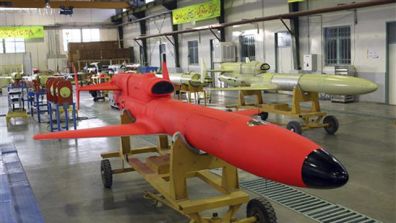
Moving on we come to Iran's "Ambassador of Death" which is a V-1 flying bomb with a range of 1,000 kilometers, a max speed of 560 MPH, and can be armed with 2 113.4 kilogram bombs or a single 450lbs bomb.

Stephen Trimble spotted this gem apparently showing a model of a stealth fighter, which looks somewhat like a YF-23.
While most of this stuff is extremely low tech, if deployed en masse it could drive the price of oil sky high, and shut down the Strait of Hormuz
Photo Credits (top to bottom): U.S Air Force, Federation of American Scientists, CNN, Fox News, The DEW Line
Thursday, June 30, 2011
Varyag: Is It A Threat?

With all the talk that China will use the Varyag to rule the western Pacific, I would like to explain why the Varyag will NOT be a SERIOUS threat to the U.S. military or the U.S.'s interests in the region.
First, the Chinese navy has no experience with carrier operations, specifically: operating cat and trap systems, landing aircraft on a moving surface, replenishing large ships while underway, and launching, arming, fueling, and repairing aircraft in heavy seas. On top of that all these shortcomings are aggravated during combat operations, as all activities will have to be done faster, at the same time with an increased degree of precision.
Second, the Varyag is of the Admiral Kuznetsov-class, and has a relatively small air wing of 26 fixed-wing aircraft (J-15, New AEW&C aircraft), and 24 helicopters (Ka-27), for a grand total of 50 aircraft. 50 aircraft is decent number for a second-tier military (Britain, France, Spain, etc...), but in a drawn out war with the U.S., 50 aircraft (of which less than half are fighters) will be nothing. Against 5+ American supercarriers, each carrying 100 aircraft, 50+ of which are fighters (not including aircraft from Japan, Guam, South Korea, and possibly the Philippines), 20 +/- fighters will be nothing.
Third, China has no escorts for the Varyag. One of the most important things needed to operate an aircraft carrier is destroyers for ASW (anti-submarine warfare) and air defense. You also need submarines to make sure no enemy submarines get close enough to take a shot at the Varyag or any of the escorts. China has both of these types of ships, but either in limited quantity or of lousy quality or both (China's nuclear submarines make enough underwater noise to make a U2 concert sound quiet). China does have diesel electric Kilo-class subs that are extremely quiet, but are too slow to escort a carrier task force. China also is beginning to build Type 052C destroyers which have a greater air defense capability than previous classes, and will probably form the backbone of Chinese carrier task forces.
Fourth, the Chinese will need a much better supply system to keep the Varyag at sea for extended periods of time. As of June 2011 the Chinese navy has a rather limited at-sea supply system, which is essential for operating an aircraft carrier(s).
While the Varyag is the only aircraft carrier the Chinese have, it will not pose a serious threat to the U.S.military. However, the Chinese military has expressed interest in building more carriers, but until the Chinese are able to field 3+ carriers with large air wings, the Varyag will not pose a serious threat.
Wednesday, June 22, 2011
Varyag To Begin Sea Trials July 1st

Defense News reports that the Chinese carrier Varyag will sail for sea trials on July 1st, but will not be officially launched until October 2012.
With the increasing tensions in and around the Spratly Islands, the Varyag would be a powerful bargaining tool, especially with countries like the Phillipines or Indonesia who have small and/or aging navies. However, Vietnam and Malaysia both have relatively large and new navies that if used with skill, could pose a threat to any Chinese forays into the Spratley Islands.
With the Varyag close to sailing it will be interesting to see how other Asian countries react to the Varyag in the South China Sea.
Monday, June 20, 2011
New Photos Show Varyag's Starboard Side

Looks like there might be another 10 barrel gatling gun in the photo.


Photo Credit: Alert 5
Friday, June 17, 2011
New Photos Show Construction Equipment Being Removed From The Varyag

The guys over at China Defense Blog spotted these photos showing construction equipment being removed from the Varyag (Shi Lang).
With the Chinese finally acknowledging the existence of the Varyag and removing construction equipment from the flight deck, it looks like the Varyag is getting ready to sail.


Photo Credit: China Defense Blog
Thursday, June 9, 2011
China Admits What The West Already Knew: Yes, We Are Building An Aircraft Carrier
Personally, I am surprised that China has not admitted the existence of the Varyag prior to yesterday as almost every defense enthusiast knows of the Varyag's existence and overhaul. I have written quite a bit about the Varyag (I can't bring myself to call it the Shi Lang), covering everything from the Varyag's weapon systems to the J-15.
With the Chinese finally admitting that the Varyag exists, it's interesting to see that the Chinese military is similar to the Soviet military in that they both are and were extremely secretive.
Thursday, May 26, 2011
New Submarine Design From France Has Some Interesting Possibilities

The SMX-25 is very large design for a diesel-electric submarine with a length of 360 and, a displacement of around 3200 tons on the surface with a displacement of around 6100 tons submerged (for more detailed specifications here is a link to DNCS's website for the SMX-25). The SMX-25 also has a range of about 8000 nautical miles at a speed of 14 to 20 knots, with a top speed of 38 knots which rivals many surface warships.
However, what makes the SMX-25 extremly interesting is the fact that the SMX-25 has 16 vertical launch tubes just aft of the front of the sail. DCNS's website states that the vertical launch tubes can be used for anti-ship missiles, land strike missiles and surface-to- missiles. The last type of missiles, surface to-air missiles (SAMs) is what raises a multitude of possibilites. Most submarines carry several MANPADS (Man Portable Air Defense Systems) like the FIM-92 Stinger or the SA-N-8 Gremlin. If you could put a real surface-to-air missile like a RIM-174 Standard ERAM missile, which is the U.S. Navy's medium range surface-to-air missile, it would be a literal bolt from the blue.
The problem with that idea is that generally submarines don't carry the type of radar used in surface-to-air missile systems thus, it would be necessary to either setup a data link with a ground based radar system or install a new radar system in the submarine. The first option is probably the better of the two as installing a new longer range radar system brings a higher risk of anti-radiation missiles (ARMs). However, if the submarine is operating far out at sea, depending on the range of the ground based radar being used it would better either to set a datalink with a warship or simply take the risk of ARMs and install a new radar system. The radar sytem used in the submarine would have to relatively compact as submarines are not known for their spacious compartments, possible radars would be the AWG-9 used on the F-14 Tomcat or a modified version of the AN/SPY-3 which will be used on Gerald R. Ford-class aircraft carriers, and Zumwalt-class destroyers.
This concept explained is just an idea, the possibility of operating SAMs from a submarine is an very interesting idea, however submarines in use today do not anywhere near the capability to launch SAMs and would need extensive modifications to do so. This concept has enormous potential and needs to be seriously looked at by the U.S. Navy and Navies around the world.
Photo Credit: DCNS
Tuesday, May 24, 2011
A Tale Of 10 Barrel Gatling Guns And Surface-to-Air Missiles


Another interesting development on board the Varyag is the addition of a 10-barreled gatling gun which as Defense Tech reports is based of the Type 730 CIWS (Close In Weapon System). Since the new type of CIWS is probably developed from the Type 730 it probably is a 30mm weapon as was the Type 730, to put this weapon into perspective the American Phalanx CIWS has a caliber of 20mm and 6 barrels along with a RPM (Rounds Per Minute)of 3,000 to 4,500, compared to the Type 730's RPM of 5,800.

Photo Credit: China Defense Blog, China Air and Naval Power, freerepublic.com
Subscribe to:
Posts (Atom)