
Showing posts with label Close Air Support. Show all posts
Showing posts with label Close Air Support. Show all posts
Sunday, February 17, 2013
The Origin of The A-10
Actually, the A-10 was a brainchild of the Fighter Mafia, but that matters not with this post.


Wednesday, June 27, 2012
Why The F-35 Can't Replace The A-10


The picture above is of an A-10 that was shot up over Baghdad in 2003. You can see several dozen bullet holes, possibly from a 23mm cannon (ZSU-23-4 or ZU-23-2). Now imagine an F-35 with that kind of damage, it would be blown out of they sky. The sky over a battlefield is by it's very nature filled with ground fire. Most of it is wild, and simply shots that missed their targets. However, every so often you will come across some sort of air defense system, be it an armored vehicle like the ZSU-23, or any sort of gun-based air defense system. And the F-35, like most other 4th and 5th generation fighters cannot take a great deal of punishment and stay in the air. That is a trade-off that occurs the more advanced the fighter.
Aircraft have to be built specifically for the close air support mission to perform that mission consistently. The F-15 and F-16 are air-superiority fighters, but they often perform the CAS mission. However, if they were fighting against an enemy with an a real IADS they would have to "shoot and scoot" before they are targeted by local air defense systems. The A-10 on the other hand can loiter over the target longer simply because it can absorb a great deal of punishment (the A-10 can take a 23mm hit almost anywhere and stay in the air, someplaces it can absorb a 57mm hit and stay up.) and bring it's pilot home.
If you want an aircraft to perform the CAS mission and be able to loiter above the battlefield, it has to be built for the mission. It has to be armored like a tank, have backup mechanical flight controls, the cockpit has to have extra armor, the canopy has to be made of bulletproof glass, it has to be able to take scores of high-caliber hits and stay in the air. The F-35, while an excellent air superiority fighter, will make a poor CAS aircraft simply because it can't take the punishment that comes with the mission.
Saturday, July 30, 2011
Saturday, July 23, 2011
Friday, July 22, 2011
Saturday, July 16, 2011
Monday, July 11, 2011
The Dutch Attack Fort Hood

Sometime between July 9th and 10th a Dutch AH-64 conducting training at Fort Hood, accidentally fired two rounds of live 30mm ammunition, as Ares reports.
Apparently, the Dutch have been using Fort Hood (which is between Austin and Waco in Texas) as a training ground for their Apache pilots. However, what is really concerning is that someone on the ground crew messed up so badly that they accidentally put live ammo in the gun. To really understand how big a 30mm round is, take a look at those rounds below.

Personally, I'm just glad no one was hurt.
Iran's Impenetrable Missile Silos & All The Other Doomsday "Weapons"

During the last few years Iran has unveiled a stream of new weapons and facilites, ranging from copies of Germany's V-1 flying bomb to ship killing flying boats that look like they were made in the 1920s to missile silos that are supposedly impenetrable. So, here are some examples of Iran's newest weapons.

This year during the Great Prophet 6 exercises Iran showed off it's new missile silos that the say can withstand direct attack (just not the nuclear kind), and can handle Shahab-3 and Sajjil-2 Medium Range Ballistic Missiles (MRBMs).

Next up is Iran's fleet of flying boats, Defense Minister Brigadier General Ahmed Vahidi stated concerning the boats "Islamic Republic of Iran is one of the few countries which managed to design, build and use flying boats in a short time.". The flying boat is designated the Bavar 2 and is supposedly armed with 1 machine gun and a camera. Defense Tech reported that Iran also claimed that the Bavar 2 cannot be seen by any radar because of it's hull's advanced design.
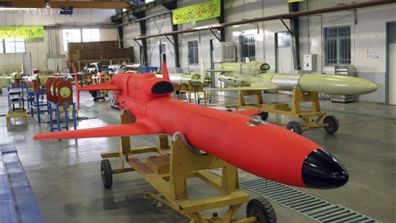
Moving on we come to Iran's "Ambassador of Death" which is a V-1 flying bomb with a range of 1,000 kilometers, a max speed of 560 MPH, and can be armed with 2 113.4 kilogram bombs or a single 450lbs bomb.

Stephen Trimble spotted this gem apparently showing a model of a stealth fighter, which looks somewhat like a YF-23.
While most of this stuff is extremely low tech, if deployed en masse it could drive the price of oil sky high, and shut down the Strait of Hormuz
Photo Credits (top to bottom): U.S Air Force, Federation of American Scientists, CNN, Fox News, The DEW Line
Thursday, July 7, 2011
Wednesday, June 22, 2011
Varyag To Begin Sea Trials July 1st

Defense News reports that the Chinese carrier Varyag will sail for sea trials on July 1st, but will not be officially launched until October 2012.
With the increasing tensions in and around the Spratly Islands, the Varyag would be a powerful bargaining tool, especially with countries like the Phillipines or Indonesia who have small and/or aging navies. However, Vietnam and Malaysia both have relatively large and new navies that if used with skill, could pose a threat to any Chinese forays into the Spratley Islands.
With the Varyag close to sailing it will be interesting to see how other Asian countries react to the Varyag in the South China Sea.
Friday, June 17, 2011
Why The Libyan Rebels Can't Win The War

First, the rebels have no real chain of command, strategic or tactical. One of the most important things needed to win a war is a chain of command and a leader who can win. There is a so-called commander in chief (CINC) named Abdul Fatah Younis, but there is no real command structure above company sized units if any.
Secondly, most of the rebels have little or no military training or discipline which is essential to have an effective military force. A military unit without training or discipline is at a serious disadvantage as evidenced by the numerous British victories during the American Revolution prior to to the stay at Valley Forge. Due to the fact that most of the rebels are former civilians they obviously would not have any military training.
Thirdly, the rebels have an extremely disorganized distribution of weaponry. It has been reported that the rebels have had to use 100 year old Lee-Enfield and Mosin-Nagant bolt-action rifles, not only those, but World War II-era Mauser K98 and Carcano bolt-action rifles. On top of this those weapons only scratch the surface of what the rebels are using, and the list goes on.
Fourth, the rebels have no heavy weapons like tanks, armored personnel carriers or artillery. The rebels are reported to have a few T-55 main battle tanks (MBTs), but have not used them en masse. The rebels are also reported to have small amounts of Type 63 and other types of rocket artillery, but no real artillery. But until the rebels can deploy armored vehicles and true artillery in sufficient numbers to support their infantry, their ability to fight Gaddafi's military is severely impaired.
The reasons I have just listed above are vital to the rebels winning the war, and until they can fix these problems their chances of beating Gaddafi are slim at best.
Photo Credit: Voice Of America
Thursday, June 16, 2011
Taiwan Buys 30 AH-64D Apaches
With China rapidly expanding it's Air Force and Navy, Taiwan in the last few months has been calling on the U.S. to release the promised F-16 C/Ds. However, this is a new development in the Taiwan vs. People's Republic of China, with Taiwan buying state of the art attack helicopters. One possibility why Taiwan is doing this, is that it is a response to the new Chinese Z-10 which is reported to have gone operational. Another possible reason the Taiwanese purchased the Apache is to deter any Chinese landings on the island, as just 4 or 5 Apaches can really hurt, especially against landing craft and amphibious armored vehicles.
However, in reality these new arrivals will not have much affect on any Chinese plans to take over Taiwan by force, because the first thing the Chinese would do is achieve aerial superiority. Even if the Apaches get off the ground and to the front line, they would be shot down quickly by either Chinese aircraft or surface-to-air missiles, like the HQ-10 which is the Chinese version of the S-300.
With Taiwan receiving the first of the new Apaches sometime next year, it will be interesting to see how Beijing reacts to this news.
Photo Credit: U.S. Navy
Wednesday, June 15, 2011
Wednesday, May 25, 2011
A Face Only It's Mother Could Love, The A-10 Thunderbolt II

The A-10 began life as a contender in the A-X program competing against the Northrop YA-9 for the job of being the Air Force's tank buster. The YA-10 first flew on May 10, 1972 and on January 18, 1973 was picked by the Air Force for production. Between 1973 and 1984 over 700 A-10s were built and, as of 2008 335 A-10s and OA-10s (The OA-10 is an A-10 used by forward air controllers, there is no difference between the two versions.) were still in service with the Air Force.
One of the defining characteristics of the A-10 is the A-10's durability. The A-10 is capable of withstanding multiple hits by small to medium caliber weapons without crashing. The A-10's durability culminates in 1200lbs of titanium armor surrounding some flight control systems and the cockpit, the titanium is so strong that it can withstand hits by 23mm ammunition and some places 57mm hits. The photo below is a graphic example of the A-10's durability, that particular A-10 was damaged when flying over Baghdad in 2003.
The A-10 is not known for it's speed and range like it's more glamorous counterparts, the F-15, F-15E and F-16, with a max speed of around 440 MPH and a combat range of roughly 250 miles depending on the mission. The A-10 may not have a high max speed like the F-16 but, the A-10 has excellent low speed handling especially at low altitude.
While the A-10 might have been built in the 1970s for destroying Soviet tanks in Germany the A-10 continues to provide excellent close air support in Afghanistan and previously Iraq and, will continue to do so until 2028 when it will be replaced by the F-35, over 50 years after the A-10's first flight
Photo Credit: U.S. Air Force
Wednesday, April 27, 2011
Chinese Naval Aviation Update
Well, folks I have it to give the ChiComms, they sure know how to deal with labor unions. Defense News reports that the head of the Taiwanese spy agency, Tsai Teh-sheng claims that the Chinese carrier Varyag will be operational by the end of this year. This a very disturbing development for every nation around the Pacific rim because prior to this Chinese air power was limited to the immediate area, now the Chinese will have the ability to project air power throughout the Pacific Ocean.

Tsai Teh-sheng claims are further supported by the fact the China's copy of the Su-33 has just been revealed. This new fighter has received the designation J-15 "Flying Shark" and, is probably going to constitute the core of the Varyag's air wing. Not much about the J-15 is known at the moment except, that it probably has the usual equipment used by carrier aircraft, strengthened landing gear, longer range and possibly better engines. The possibility that the J-15 has better engines than a normal Su-27 as the Su-33 is the carrier version, is highly unlikely because the Chinese have had trouble producing a good indigenous engine for use in fighter aircraft, usually opting to purchase engines from the Russians and copy them either under license or illegally.
While the J-15 is a step forward for the Chinese military, the J-15 is not likely to be able to compare with the Super Hornet now in service in the U.S. Navy due to fact that Chinese pilots have had no real air-to-air combat experience since the confrontation with Taiwan in the Second Taiwan Straight Crisis in 1958. Aviation Week also reports that the J-15 is comparable with a F/A-18C which is now being replaced by the F/A-18E/F Super Hornet.
All in all the J-15 is a step forward for the Chinese but, if push comes to shove between the U.S. and China, I don't believe the J-15 or the surface forces of the Chinese Navy are going to be a serious threat. However, as I said the Chinese surface forces won't be a "serious" threat but, they will be a threat worth keeping an eye on.
Photo Credits (from top to bottom): Military-Today.com, Defense Tech,
Subscribe to:
Posts (Atom)