Showing posts with label SSGN. Show all posts

Monday, July 18, 2011

The Virginia-class: The New Ohio-class

     Aviation Week reported last Thursday that the Navy was considering canceling the proposed SSBN(X) project to meet budget reduction requirements. Marine Corps Gen. James Cartwright stated at the Defense Writers Group breakfast that the Pentagon was considering lengthening Virginia-class submarines to be capable of carrying Trident C-4 SLBMs (Submarine Launched Ballistic Missiles).
     The idea of lengthening Virginia-class submarines has been discussed before, the idea being to insert an extra 27.4 meter section into a normal Virginia-class sub, and fill the section with 194  Tomahawk cruise missiles. 
     The proposal to insert SLBMs into a Virginia-class certainly has merit, but with congress in a stalemate over the debt ceiling, the chances of this happening, are slim at best.
     

Photo Credit: U.S. Navy


Monday, June 6, 2011

Next Generation Of American Fast Attack Submarines

     For those of you who have read my previous post about new Russian submarine classes you might remember that few if any new Russian subs have reached service yet, but that is not the case for the newest American fast attack submarine class. The Virginia-class is the latest fast attack sub class in the U.S. Navy, with improved stealth and armament over the older Los Angeles-class submarines. 
     Virginia-class submarines have a displacement of 7,800 tons submerged but, I could not find the displacement when on the surface. Virginia-class subs have a length of 115 meters and a beam of 10 meters, along with a draught of 9.75 meters. Virginia-class subs have a top speed of 32 knots submerged and a top speed of 25 knots on the surface but, there are reports of Los Angeles-class subs going up to 33 knots. Thus, it would seem likely that Virginia-class subs have a much greater speed than the Navy admits. Virginia-class submarines have an operational depth of around 250m but, the max diving depth is classified.
     Virginia-class submarines are equipped with 12 VLS tubes (Vertical Launching System) capable of firing BGM-109 Tomahawk cruise missiles. Virginia-class subs also have 4 533mm torpedo tubes that launch both the Mark 48 torpedo along with the new Submarine Launched Mobile Mine (SLMM) when it becomes available. While on the subject of the Virginia-class's armament, a couple of months ago Defense Tech reported that Electric Boat pitched the idea of building stretched Virginia-class subs equipped with 194 Tomahawk cruise missile for only $500 million more or a 20 percent higher cost (Virginias already cost around 2.5 billion dollars each) as a temporary replacement for the Ohio-class SSBNs during the 2020s.
     The picture above is a graph showing the decrease in noise produced by Soviet, Russian and American submarines from 1960 to around 2008 or 2009. The graph show how American subs have always been quieter than their Soviet or Russian counterparts but, in recent years the graph shows how the difference in noise produced has gotten smaller and smaller with the Severodvinsk-class (Yasen-class) almost as quiet as the Virgina-class (SSN-774). On top of this there have been incidents where Virginia-class submarine's hull coating falls off the side of the sub. Hull coatings are materials that dampen internal sounds and to some degree absorb active sonar pulses thus, if the hull coatings fall off the sub's sonar signature increases, making it easier to detect.
     While the Virginia-class has some drawbacks such as it's high cost and lousy hull coatings, it is also the best class of submarines in the sea today easily surpassing the British Astute-class and Russian Yasen-class in all aspects, with the possible exception of noise produced. As the U.S. faces an ever strengthening China and Russia these subs will prove that it was money well spent.


Photo Credit: U.S. Navy, Office Of Naval Intelligence

Monday, May 30, 2011

The Next Generation Of Russian Submarines

     When the Cold War ended in 1991 all of the Russian Ministry of Defense's projects were either outright cancelled or delayed for several years because of a lack of funding. Now, 20 years after the collapse of the Soviet Union, Russia has begun to replace some of it's Cold War-era military equipment, especially in the area of submarines. As of 2011 Russia has 3 new classes of submarines in the works or somewhat operational, these classes are the Yasen-class attack submarines (SSN), the Borei-class ballistic missile submarines (SSBN) and the Lada-class diesel-electric submarine (SSK).
     The Yasen-class submarines are nuclear powered with a max speed of 35+ knots submerged and max speed of 20 knots on the surface. The Yasen-class has length of 120 meters and a beam of 15 meters along with a draft of 8.4 to 10 meters and, a displacement of 5,800 to 9,500 tons on the surface and a displacement of 11,800 tons submerged. Yasen-class submarines are believed to be armed with 8 torpedo tubes used for torpedoes and mines along with 8 vertical launch tubes for SS-N-26 SLCMs (Submarine Launched Cruise Missile) and SS-N-27 SLCMs.
    The Borei-class SSBNs are the latest Russian SSBN and will carry 16 RSM-56 Bulava SLBMs on early ships and 20 Bulava SLBMs on the unofficial Borei II-class. The Borei-class has a length of 160 meters and a beam 13.5 meters along with a draft of 10 meters. The Borei-class has a displacement of 14,700 tons on the surface and a displacement of 24,000 tons submerged. The Borei-class is believed to have operational diving depth of 380 meters and a maximum diving depth of 450 meters. Borei-class submarines are reputed to have a submerged speed of around 29 knots and a surfaced speed of 15 knots. An interesting side note about the Borei-class submarines is that they are the first class of submarines in the Russian Navy to use pump-jet propulsion which has the advantage of reducing the sub's sonar signature.
     Last but, by no mean least is the latest in the long line of Russian diesel-electric submarines, the Lada-class SSKs. The Lada-class is improved version of the Improved Kilo-class submarines with improvements such as newer combat systems, lower displacement and possibly air independent propulsion . The Lada-class submarines have a length of 72 meters, a beam of 7 meters and a draft of 6.5 meters. The Lada-class has a displacement 2,700 long tons submerged and displacement of 1,765 tons on the surface (versus 3,500 and 2,300 tons for the Kilo-class). The operational diving depth of the Lada-class is around 250 meters and a max diving depth of 300 meters. The Lada-class is armed with 6 533mm torpedo tubes that can fire both standard torpedoes and P-700 SLCMs (see SS-N-26 above).
     With the ending of the Cold War approaching it's 20th anniversary much of the U.S.'s and Russia's equipment is beginning to age out and needs to be replaced (read Minuteman III ICBMs, Black Hawk and Huey helicopters, etc...). And as older equipment it will interesting to find out more and more details about how these new systems work. Also the top picture is not a photo of a new class of subs, it is a photo of an Akula-class sub.


Photo Credit: Department Of Defense, Military-Today.com

Thursday, April 28, 2011

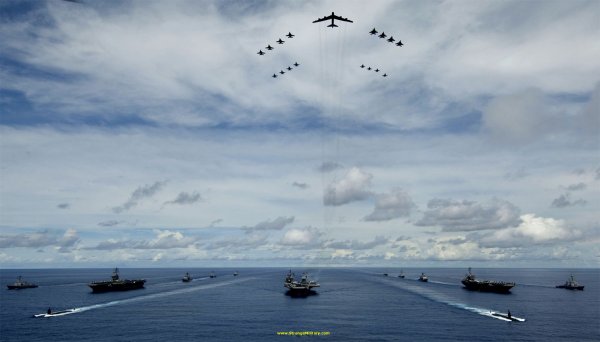
What Happend To the 600-Ship Navy?

     During the 1980s at the height of the Cold War, Ronald Reagan pushed a massive military modernization and expansion plan that for the Navy would have resulted in a 600-Ship Navy. My question is what happened to that idea?
     When the Soviet Union collapsed in 1991, governments around the world began to make massive budget cuts to their military's, one example is the so called Royal Navy and British Army, both of which are skeletons of their former selves. Since the collapse of the Soviet Union most governments have begun rearming (Britain hasn't) and putting their military's back together. Since 1991 the U.S. has expanded it's military but, the 600-Ship Navy idea is nowhere to be seen. The 600-Ship Navy has become a victim of several groups, socialists/communists who want to redistribute wealth and want a larger government, cost cutters who think now the the USSR is gone we can put the money into other programs, peace groups who think there should be no military at all and the list goes on.
      Few poeple outside the military realize how dire the situation really is, since 1987 the Navy has gone from the 1980s high of 594 ships to about 290 ships in service in 2011. Since 1987 our Navy has been more than halved and almost nobody in the media, the government or the people realizes it. Our Navy has been second to none since the end of WWII when we had over 6,000 ships and still are larger that the next seven navies combined but, China is rabidly increasing the size of their Navy and as of 2011 are second in size to only to the U.S. and climbing.
     The Navy is starting to begin building ships a higher rate in the last couple of years but, as I said a couple of articles ago the Navy is crumbling before our very eyes. And if we do not correct this situation, the cosequences could be extremly bad to say the least.


Photo credit: New Wars