Tuesday, July 16, 2013

Panama Intercepts NorK Ship Carrying Missile Parts (Updated)


Panama has detained a North Korean-flagged ship after it was found to be carrying undeclared weapons hidden underneath sugar containers, the country's president said. 

President Ricardo Martinelli said the ship, the Chong Chon Gang, was intercepted as it approached the Panama Canal from Cuba and as it was stopped the 35-man crew rioted and the captain tried to kill himself. 

The 'sophisticated missile equipment', hidden in containers of brown sugar, were detected after Panamanian authorities stopped the ship, suspecting it was carrying drugs. 

Martinelli said the undeclared military cargo appeared to include missiles and non-conventional arms and the ship was violating United Nations resolutions against arms trafficking.

Panamanian authorities have only searched one of the ship's five cargo holds so far, said Luis Eduardo Camacho, a spokesman for the president. 

'This material not being declared and Panama being a neutral country, a country in peace, that doesn't like war, we feel very worried about this war material and we don't know what else will have... passed through the Panama Canal,' Martinelli said. 

The governments of North Korea and Cuba have so far not commented on Martinelli's remarks. 

Hugh Griffiths, an arms trafficking expert at the Stockholm International Peace Research Institute, said the seized ship is called Chong Chon Gang and has been on the institute's suspect list for some time. 

He said the ship had been caught before for trafficking narcotics and small arms ammunition. It was stopped in 2010 in the Ukraine and was attacked by pirates 400 miles off the coast of Somalia in 2009. 

Griffiths' institute has also been interested in the ship because of a stop it made in 2009 in Tartus - a Syrian port city hosting a Russian naval base. 

The vessel was pulled over near the port of Manzanillo on the Atlantic side of the canal.


We're going to keep unloading the ship and figure out exactly what was inside,' Martinelli told Panamanian television late on Monday, without giving further details.

'The world needs to sit up and take note: You cannot go around shipping undeclared weapons of war through the Panama Canal.'

Griffiths also said the institute earlier this year reported to the U.N. a discovery it made of a flight from Cuba to North Korea that travelled via central Africa. 

'Given the history of North Korea, Cuban military cooperation and now this latest seizure, we find this flight more interesting,' he said. 'After this incident there should be renewed focus on North Korean-Cuban links.' 

Martinelli said the captain had a heart attack and also tried to commit suicide during the operation.
He said authorities had been tipped off some days ago that the ship might be carrying drugs.

He posted a picture of what appeared to be a green tubular object sitting inside a cargo container or the ship's hold.
A spokeswoman for the canal said she did not have any more information and referred questions to the attorney general and the office did not immediately return requests for comment.

Javier Caraballo, Panama's top anti-drugs prosecutor, told local television the ship was en route to North Korea. 

The Communist country is barred from importing large weapons under United Nations sanctions. 

The UN strengthened sanctions against the country in March following it nuclear tests that set tensions rising in the area. 
About 15,000 ships pass through the canal every year. 

     A normal shipping container is about 12.5m with the largest container being about 17m. The cylindrical objects in the container (see photo above) stretch for most of the length of the container. That would put them in excess of 10m, possibly more. If I had to guess those are parts for some North Korean IRBM, which one, I cannot guess. Congrats to the Panamanians for intercepting these parts.

Update: SMS Msgt over at Elements of Power points out that the cylindrical objects are more similar to parts to a Fan Song radar system. The Fan Song is associated with the SA-2 Guideline.


Friday, July 12, 2013

Flashback Fridays: H-Series Battleships

     This week's Flashback Friday focuses on Nazi Germany's H-series battleships. The H-series was a series of battleship proposals put forth by the Third Reich for Plan Z. Of 5 H-series proposals, only one class made it to construction, the H-39. The other classes were the H-41, H-42, H-43 and the titanic H-44. Plan Z called for six H-39 battleships, of which construction began on two, the other four never made it to construction. Both H-39s were scrapped in November 1941. It would take several paragraphs to explain the specifications on all five H-series proposals, so below is a table of specs from German Warships: 1815-1945:
DesignH-39H-41H-42H-43H-44
Displacement56,444 t (55,553 long tons)68,800 t (67,700 long tons)90,000 t (89,000 long tons)111,000 t (109,000 long tons)131,000 t (129,000 long tons)
Length277.8 m (911 ft 5 in)282 m (925 ft 2 in)305 m (1,000 ft 8 in)330 m (1,082 ft 8 in)345 m (1,131 ft 11 in)
Beam37 m (121 ft 5 in)39 m (127 ft 11 in)42.8 m (140 ft 5 in)48 m (157 ft 6 in)51.5 m (169 ft 0 in)
Draft10 m (32 ft 10 in)11.1 m (36 ft 5 in)11.8 m (38 ft 9 in)12 m (39 ft 4 in)12.7 m (41 ft 8 in)
Main8 × 40.6 cm (16.0 in)8 × 42 cm (17 in)8 × 48 cm (19 in)8 × 48 cm (19 in)8 × 50.8 cm (20.0 in)
Secondary12 × 15 cm (5.9 in)
and 16 × 10.5 cm (4.1 in)
12 × 15 cm (5.9 in)
and 16 × 10.5 cm (4.1 in)
12 × 15 cm (5.9 in)
and 16 × 10.5 cm (4.1 in)
12 × 15 cm (5.9 in)
and 16 × 10.5 cm (4.1 in)
12 × 15 cm (5.9 in)
and 16 × 10.5 cm (4.1 in)
AA16 × 3.7 cm (1.5 in)
and 12 × 2 cm (0.79 in)
32 × 3.7 cm (1.5 in)
and 12 × 2 cm (0.79 in)
28 × 3.7 cm (1.5 in)
and 40 × 2 cm (0.79 in)
28 × 3.7 cm (1.5 in)
and 40 × 2 cm (0.79 in)
28 × 3.7 cm (1.5 in)
and 40 × 2 cm (0.79 in)
Torpedoes6 × 53.3 cm (21.0 in)6 × 53.3 cm (21.0 in)6 × 53.3 cm (21.0 in)6 × 53.3 cm (21.0 in)6 × 53.3 cm (21.0 in)
      Several things stand out from the specs of the H-series, as the war went on (the H-41 through H-44 were designed from 1940-1942) AA armament increased in the designs, as evidenced by the increasing numbers of 37mm and 20mm cannons. The draft of the H-series also increased, to the point where the H-42, H-43, and H-44 would have been unable to use any German port without being dredged. Also, the main armament of the H-44 would have been 8 508mm guns which would have been the largest naval guns ever put to sea, larger than even Japan's Type 94 gun. It's also probable that the torpedo tubes would have been removed by the time any H-series battleship made it to construction.
       The H-39 was expected to fight at relatively close ranges, and as such was designed with vertical side belt armor, the upper side belt being 145mm, the lower side belt 220mm thick. It was calculated* that an H-39 would have been immune to a 16"/45 shell from 11km to 21km on the lower side belt, though a 16'/45 shell would have been able to penetrate the upper side belt at any distance. Deck armor ranged from 50mm-150mm depending on the area, magazines having the thickest deck armor, and machinery spaces having the thinnest armor. Turret armor ranged from 130mm-385mm thick, barbette armor ranged from 365mm to 240mm thick, with armor on the secondary battery being significantly thinner. The H-41 had increased armor on the deck, otherwise the armor scheme was the same as the H-39. Armor specs on the H-42 through H-44 are unavailable, but it would stand to reason that all three would have drastically increased armor in every area. 
      To get an idea of the size of the H-39 here is a photo where an depiction of an H-39 is superimposed next to the Tirpitz.
     The H-series battleships were for the most part hypothetical designs with the H-39 and H-41 being the most practical designs of the series. The designs after that, the H-42, -43, and -44, were all no more than mental exercises because by the time the designs were finished Germany was not in position to build anything larger than a destroyer for the duration of the war. In fact designs made after the H-41 were ordered by Hitler, and that can be seen in their massive size and armament. The H-39 and H-41 can be compared to the Montana-class in that they were practical designs, but the role they were meant to fulfill (slugging matches against other battleships) was taken over by aircraft and the materials slated for use in construction were diverted to more urgent needs. As to the H-42, -42, -44, they were no more than mental exercises along with the fact that they were huge, cumbersome, and impossible to build, similar to the Tillman Battleships.    

Photo Credit: Richard Allison
*Garzke, William H.; Dulin, Robert O. (1985). Battleships: Axis and Neutral Battleships in World War II. Annapolis: Naval Institute Press.

Thursday, July 11, 2013

Saudi Arabia Pointing Missiles At Iran And Israel


Saudi Arabia is targeting Israel and Iran with powerful ballistic missiles, new satellite photography shown by military experts to The Daily Telegraph suggests.
Images analyzed by experts at IHS Jane’s Intelligence Review have revealed a hitherto undisclosed surface-to-surface missile base deep in the Saudi desert, capable of hitting both countries.
The analysts spotted two launch pads with markings pointing north-west towards Tel Aviv and north-east towards Tehran. They are designed for Saudi Arabia’s arsenal of truck-launched DF3 missiles, which have a range of 1,500 to 2,500 miles and can carry a two-ton payload.
The base, believed to have been built within the past five years, gives an insight into Saudi strategic thinking at a time of heightened tensions in the Gulf. While Saudi Arabia does not have formal diplomatic relations with Israel, it has long maintained back-channel communications as part of attempts to promote stability in the region.
The two countries also have a mutual enemy in Iran, which has long seen Saudi Arabia as a rival power in the Gulf. Experts fear that if Iran obtains a nuclear weapon, Saudi Arabia would seek to follow suit.
Analysts at IHS Jane’s believe that the kingdom is in the process of upgrading its missiles, although even the DF3, which dates back to the Eighties, is potentially big enough to carry a nuclear device.
The missile base, which is at al-Watah, about 125 miles south-west of the capital, Riyadh, was discovered during a project by IHS Jane’s to update its assessment of Saudi Arabia’s military capabilities.
It serves as both a training and launch facility, with the missiles stored in an underground silo built into a rocky hillside. To the north of the facility are two circular launch pads, both with compass-style markings showing the precise direction that the launchers should fire in.
The Chinese-made missiles are not remotely guided and have to be aimed at their target before firing.
“One appears to be aligned on a bearing of approximately 301 degrees and suggesting a potential Israeli target, and the other is oriented along an azimuth [bearing] of approximately 10 degrees, ostensibly situated to target Iranian locations,” said the IHS Jane’s article, which is published Thursday.
While the trailer-launched missiles could theoretically be fired from any location, the idea of having pre-planned directional markers was to ensure that they could be deployed in accurate fashion as quickly as possible, said Allison Puccioni, an image expert at IHS Jane’s.
“There is a marked out spot for the launch truck to park in, which will facilitate an expedited launch,” she said.
Robert Munks, deputy editor of IHS Jane’s Intelligence Review, said: “Our assessment suggests that this base is either partly or fully operational, with the launch pads pointing in the directions of Israel and Iran respectively.
“We cannot be certain that the missiles are pointed specifically at Tel Aviv and Tehran themselves, but if they were to be launched, you would expect them to be targeting major cities.
“We do not want to make too many inferences about the Saudi strategy, but clearly Saudi Arabia does not enjoy good relations with either Iran or Israel.”
Officials at the Saudi embassy in London did not respond when contacted by The Daily Telegraph.
The Israeli embassy in London said: “We have no comment on this matter”.
David Butter, an associate fellow with the Middle East and North Africa programme at Chatham House, a London-based foreign affairs think tank, said: “It would seem that they are looking towards some sort of deterrent capability, which is an obvious thing for them to be doing, given that Iran too is developing its own ballistic missiles.”
He added, though, that the Saudis would know that the site would come to the attention of foreign intelligence agencies, and that the missile pad pointed in the direction of Israel could partly be just “for show.”
“It would give the Iranians the impression that they were not being exclusively targeted, and would also allow the Saudis to suggest to the rest of the Arab world that they still consider Israel a threat.”
Oil-rich Saudi Arabia considers itself one of the pre-eminent powers in the Gulf region, but its Sunni Islam leadership has long been at loggerheads with the Shia mullahs of Iran.
The conflict in Syria, in which Saudi Arabia has backed the Sunni-dominated rebels and Iran has backed the Shia-dominated regime of President Bashar al-Assad, has heightened fears of a wider sectarian conflict.
A confidential diplomatic cable revealed in the “Wiki-Leaks” disclosures of 2010 said that King Abdullah of Saudi Arabia repeatedly exhorted the United States to launch military strikes against Iran’s nuclear programme and “cut off the head of the snake.”
     Saudi has been thought to have had ballistic missiles for years, but the news here is that this base was heretofore unknown. In a check of Missile Threat, Saudi Arabia is not listed as possessing any ballistic missiles. There have rumors about the possibility, but this is the first confirmation of them.


Pegasus-class: The 1970s LCS

8 Harpoons, a 76mm gun, and a top speed of 48 knots. Faster and better armed than the LCS, launched in '75, decommissioned in '91.  Video shows off the Pegasus, and provides an overview of hydrofoil technology.


Video Credit: Jeff Quitney


Wednesday, July 10, 2013

URR Is Discussing Mothball Fleets Over At BTHBTS

Hope on over and read.

Russian Navy To Receive 24 Submarines By 2020


ST. PETERSBURG, July 7 (RIA Novosti) – The Russian Navy will receive 36 warships in 2013, an unprecedented number in Russia’s history, Navy Deputy Commander-in-Chief, Vice Admiral Alexander Fedotenkov said on Sunday.
“During this year, 36 combat ships, fast attack crafts and support vessels will join the Russian Navy. This has never happened before,” Fedotenkov said at the International Maritime Defense Show in St. Petersburg.
Russian Navy warships are now performing missions in all areas of the World Ocean, with over 60 combat ships currently at sea, he said.
Defense Minister Sergei Shoigu said in March the Russian Navy would receive 24 submarines and 54 warships of various classes by 2020.
As a result of the implementation of the state rearmament program to 2020, the navy should receive eight nuclear-powered strategic submarines, 16 multirole submarines and 54 warships of various classes,” Shoigu said.
The eight strategic missile boats include three Borey and five Borey-A class vessels (SSBN) armed with Bulava ballistic missiles.
The 16 multi-purpose submarines include eight Graney class nuclear-powered attack submarines (SSN) and improved Kilo and Lada class diesel-electric (SSK) boats.
In addition to submarines, the navy will receive Admiral Gorshkov class frigates and Steregushchy class corvettes, Buyan class corvettes and Ivan Gren Class large landing ships.
Russian President Vladimir Putin said last year that the procurement of new warships and submarines for the Navy would be a priority over the next decade. The Russian government has allocated five trillion rubles ($166 bln) or a quarter of the entire armament procurement budget until 2020 for this purpose.
     Russia is expanding their navy, but I find it hard to believe that they can build 8 SSNs and 8 SSBNs in seven years. It took four years to build the Severodvinsk, and the Kazan is slated to be launched in 2014, a build time of ~3 years. To build 16 nuclear submarines is possible for the Russians, but a building program like this hasn't been around since the end of the Cold War. 


Tuesday, July 9, 2013

Video: Kamikaze Hit On The USS Tennessee

     22 dead, 107 wounded. 2 days later the Tennessee was back providing fire support.


Monday, July 8, 2013

India's New Carrier Almost Ready


India, looking to boost its naval presence in the Indian Ocean, is one step closer to putting its first indigenous aircraft carrier (IAC) into the water—as soon as August.

The first sea trials are likely to follow 10 months later, says a senior government official. Still, the IAC, named INS Vikrant after India's first carrier, will not see deployment for another five years.

The carrier is being constructed at the Cochin shipyard and the vessel “will be floated out on Aug. 12 and taken to the repair dock to carry out remaining work,” says Commo. K. Subramaniam, chairman and managing director of Cochin Shipyard Ltd. Hull work will be completed by June 2014, he adds.

The carrier is expected to be handed over to the navy for induction by January 2018.

The 45,000-ton IAC is estimated to cost $5 billion.

Cochin shipyard personnel have been working with the navy on the vessel for more than six years. The contract for the construction of the aircraft carrier was signed in 2007, and the keel was laid in February 2009, Subramaniam says.

The IAC was originally slated to enter service in 2014. Through last year, Indian officials insisted it could be 
commissioned in 2017. But a number of factors led to construction delays, including lack of adequate and appropriate steel from Russia and technical issues in the gearbox and other systems, a defense ministry official says.

India's other aircraft carrier, the 45,000-ton, 284-meter-long (932-ft.) INS Vikramaditya, formerly the Russian Kiev-class Admiral Gorshkov, is undergoing trials and will soon join the current sole carrier, the INS Virat.

Increasing India's naval force in the Indian Ocean is crucial, especially to combat sea piracy, says Ajay Lele, a defense pundit at the New Delhi-based Institute for Defense Studies and Analyses.

     India is finally launching their first homebuilt aircraft carrier, with a second planned. This is a continuation of the arms race throughout South and East Asia. Still, it is good to see the Indians making advances, only question is which side will they be on when the shooting starts.

Friday, July 5, 2013

Flashback Friday: Tillman Battleships

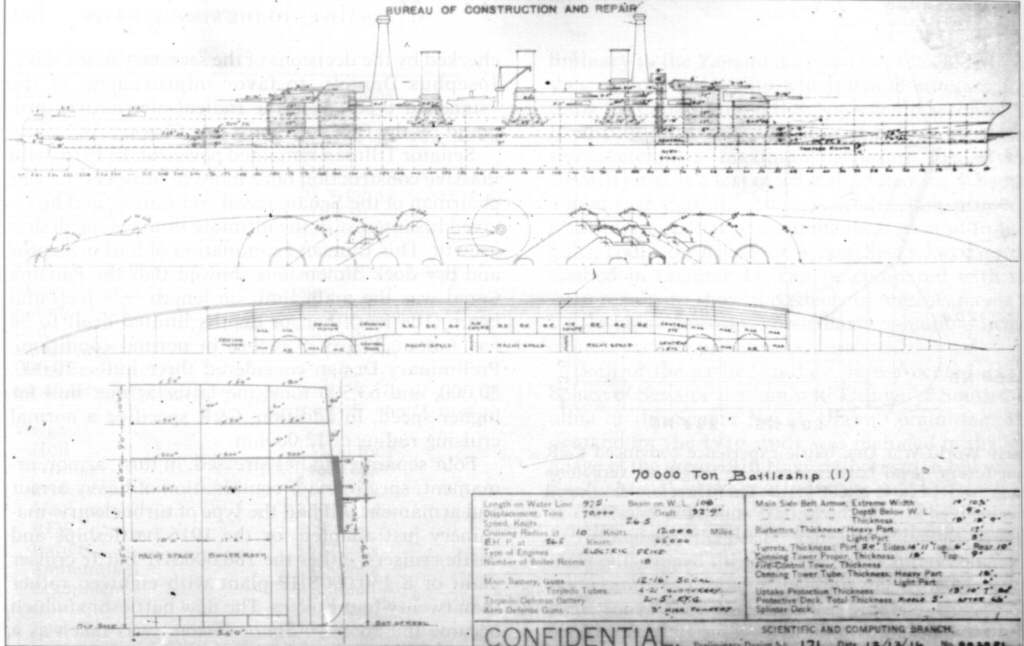
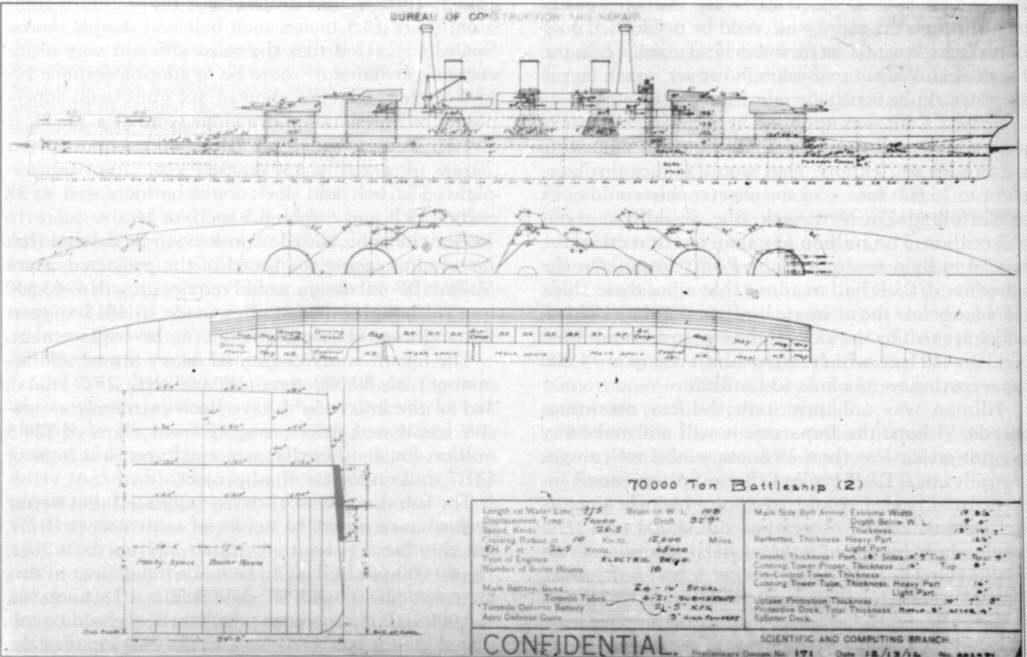
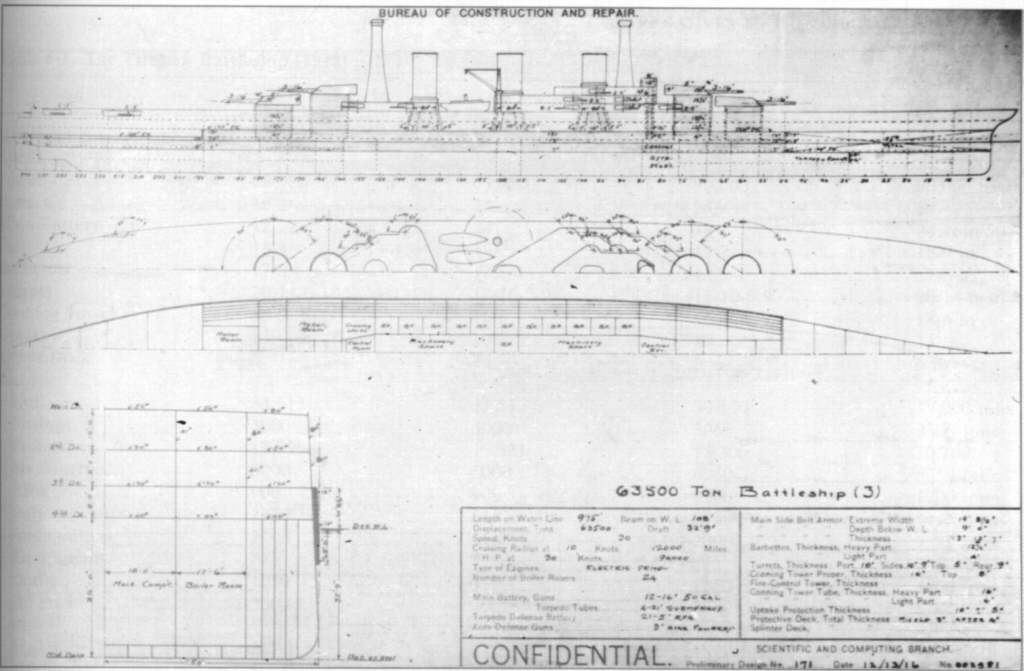
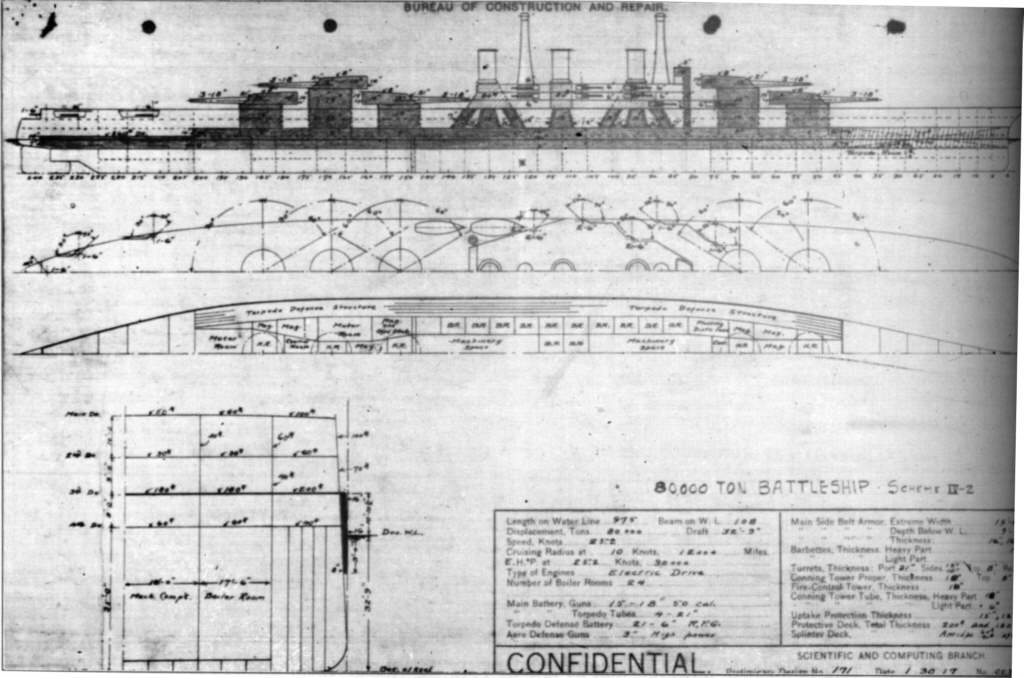
     This week's Flashback focuses on the Maximum Battleship designs of 1916. In 1912-13 Senator Benjamin "Pitchfork" Tillman asked the Navy to provide designs for the largest practical battleship the Navy could use. Tillman was on the Senate's committee on Naval Affairs, and he was unhappy with the Navy building battleships larger than what Congress authorized. It was not until 1916, after Senator Tillman asked again, that the Navy provided designs for four battleships. It would take several paragraphs to explain all the specs on the designs, so here is a table of specs from the Wells Bros. Battleship Index:

DesignTillman BattleshipsSouth Dakota(BB-49) class (For comparison) 
#1#2#3#4 IV-1 IV-2 
Date13 Dec 191613 Dec 191613 Dec 191629 Dec 191630 Jan 191730 Jan 19178 Jul 1918
Displacement, in tons70,00070,00063,50080,00080,00080,00043,200
Waterline Length, in feet (meters)975 (297.2)660 (201.2)
Beam, in feet (meters)108 (32.9)106 (32.3)
Draught, in feet (meters)32.75 (10.0)32.75 (10.0) 
Max. Speed, in knots26.5 26.53025.225.225.223.5
Max. Power, in EHP (SHP)65,000 EHP (130,000 SHP)65,000 EHP (130,000 SHP)90,000 EHP (180,000 SHP)90,000 EHP (180,000 SHP)90,000 EHP (180,000 SHP)90,000 EHP (180,000 SHP)60,000 SHP
Number of Boilers182412
Main BatteryTwelve 16"/50 in four 3-gun turretsTwenty-four 16"/50 in four 6-gun turretstwelve 16"/50 in four 3-gun turretsTwenty-four 16"/50 in four 6-gun turretsThirteen 18"/50 in five 2-gun turrets and one 3-gun turretFifteen 18"/50 in five 3-gun turretsTwelve 16"/50 in four 3-gun turrets 
Belt Armor18"/9"13"/7"13"/7"18"/9"16"/8" 16"/8" 13.5"/8"
Barbette Armor17"/5"12.5"/4"12.5"/4"17"/5"15"/5"15"/5"13.5"/4.5"
Turret Armor20"/14"/6"10"18"/10"/5"/9"18"/10"/5"/9"20"/14"/6"/10"21"/12"/8"/14" 18"/10"/5"/9"
Deck Armor5"3"3"5"5" 5" 5"/1.75"
ImagesClick HereClick HereClick HereClick HereClick Here
Notes In some ways, this is a greatly enlarged South Dakota (BB-49) class battleship. While the South Dakota design was not finalized until 1918, design work was well under way at this point.Similar to design #1, but trades off some armor for increased armament. (BuOrd considered 13.5" to be the practical limit for armor plate thickness.) Design 3 was a "fast battleship". At the time, the General Board was not particularly interested in fast battleship designs.Adding 10,000 tons to the displacement allowed the armor of Design #1 to be combined with the main battery of Design #2. Had these ships actually been built, the guns probably would have been 18"/48 Mk1 

     A note of clarification, the South Dakota-class referenced in the table above was canceled due to the Washington Naval Treaty, and is not the South Dakota-class of WWII.
     Of the four designs given to Tillman it was #4 which was considered the most practical, and the IV-1 and -2 were spin-offs of design #4. It was designs 1 and 3 which influenced the design of the South Dakota-class (BB-49). The South Dakotas would have had a similar main armament, but only 13.5" belt armor, and a top speed of 23.5 knots. The South Dakotas would have had a displacement of ~43,200 tons.
     There has been speculation of class of Tillman battlecruisers (based in Design #3) had there not been a Washington Naval Treaty, however the Navy never considered it on the grounds that it would been to radical a change in battlecruiser design. Design #3 did have a speed of 30 knots easily making it a fast battleship by WWII standards, and does have specs similar to what an enlarged Iowa could have had.
     The Tillman battleships were not built mainly due to the Washington Naval Treaty, but frankly these designs were not really serious. Rather, they were speculation as to what the Navy might ask had the naval arms race post-WWI continued between the World Wars. These designs are in some way comparable to the Yamato-class, and would have been extremely susceptible to air attack. In the end the Tillman battleships were no more than mental exercises by the Navy taking battleship designs to the extreme, and are rivaled only by the Yamatos, the N3-class, the #13-class, and perhaps the H-41 and -42.

Further reading:

Photo Credit: Model Ship Gallery

Thursday, July 4, 2013

Independence Day

     237 years ago 56 men from 13 colonies signed the Declaration of Independence declaring the 13 colonies free from British rule. To those men, thank you.

Wednesday, July 3, 2013

Philippines Set To Buy Two Italian Frigates

      From the Global Nation Inquirer:


MANILA, Philippines — The Philippines is set to buy two Maestrale-class frigates from Italy, a defense official said Wednesday, as the Asian nation races to upgrade its military amid mounting territorial disputes with China.

The frigates, along with 12 FA-50 fighter aircraft, are the most significant items on the government’s P75-billion ($1.7-billion) military modernization budget over the next five years, Defense Undersecretary Fernando Manalo said.

“We are modernizing not because we want to go to war with China,” he told a news conference.

He said the government had a sworn obligation to defend the “West Philippine Sea,” using the government’s preferred term for Philippine-claimed areas in the South China Sea.

“We are not saying that this is part of our preparations to assert our sovereignty in the West Philippine Sea. What we are saying is that we cannot just give them up.”

The frigates would add to two refurbished Hamilton-class cutters formerly used by the US Coast Guard that the Philippines acquired from its US ally to upgrade its ageing navy fleet, which includes some vessels that first saw action in World War II.

Manalo said the navy had already decided to acquire two new Maestrale-class frigates instead of buying used ones from the Italian navy, and had budgeted P18 billion for them.
The Philippines could be ready to tender by the end of the year, he added.

Meanwhile, the government had allotted P18.9 billion to acquire the fighter aircraft, which are built by South Korea, he added.
The modernization budget also provides for building or improving facilities to berth and provide maintenance to the vessels on the military’s shopping list, Manalo said.

President Benigno Aquino vowed Monday to rebuild the air force by 2016.

The Philippines, which has one of the weakest military forces in the region, retired the last of its US-designed F-5 fighters in 2005.

     Emphasis mine. The Philippines buying the frigates is old news, but President Aquino's remarks concerning the air force are brand new. The Philippines have bought 12 K/A-50s, but the Philippines have not a real fighter force since the early 1990s with their old F-8s. Unfortunately the last of the F-8s were lost when Mt. Pinatubo erupted in '91. 12 K/A050s will not provide the Philippines with any real measure of air power, the Philippines would have to buy at least 2 dozen dedicated fighters to be able to achieve local air superiority over disputed islands in the South China Sea. Maybe some surplus F-16s from the USAF? 
      As to the frigates, this is a bit of good news fro the Philippine Navy, as the most modern warships they have to date are a pair of ex-USCG Hamilton-class cutters which have no ASuW or AAW capability. Hopefully we will see the Philippines increase their naval capability further over the next few months.

Tuesday, July 2, 2013

Remember When, The Naval Gun Factory

This was a time when the Navy could build it's weapons in-house, and on time. About 0:20 on part 2 notice the narrator mentions that the machine is capable of grooving liners up to 18"/47 caliber, that was the largest naval gun ever produced by the Navy in terms of caliber. Watch both videos, it'll be worth your while.
Part 1:
Part 2:

Monday, July 1, 2013

Analysis of Alternatives: Zumwalt-class DDGs

     In 2011 The Navy began construction of it's latest class of DDGs, the Zumwalt-class. The mission of the Zumwalt-class is shore bombardment and cruise missile attack, with a little bit of AAW thrown in as well. However, the Zumwalt-class does not have sufficient VLS (80 missile cells) space to provide effective AAW while at the same time carrying the number of Tomahawks needed. At the same time Zumwalt-class has concerns about it's seakeeping capabilities  due to it's tumblehome hull design. The Zumwalt-class will also not be built it large numbers, with a production run of only three ships. Leaving the vast majority of the Navy without any high caliber guns for shore bombardment. Here are what I believe are solid alternatives to the Zumwalts.
     1. Modify Burke-class destroyers under construction and DDGs 85-112 to mount a single Mk 71 8"/55 caliber gun on the bow. The Mk 71 was developed back in the 1970s to fill the growing gap in naval gunfire support, as there were few guns in the Navy larger than 5". The Mk 71 offers improved range over a 155mm gun firing the M795 (27km vs 22.5km) and a larger round (118kg v 46.7kg). Off the shelf is a match for any 155mm gun in U.S. inventory firing any type of ammunition (the only acceptation being the LRLAP round).
     I would argue that the Mk 71 is better than the AGS because the AGS has no anti-ship capability, and fires only one round, the LRLAP. With only a small amount of LRLAPs being purchased for only 6  operation guns (3 Zumwalts, 2 guns apiece), the cost per round will be abnormally high. To sum it up, I'd like to quote ComNavOps over at Navy Matters.

  • Cost – when the Navy committed to the AGS the Mk71 development costs were already long since paid for.  The gun was essentially free and a prototype had already been successfully tested.  Advanced rounds, if desired, would have entailed additional costs just as for the AGS.
  • Explosive Power – the 8” round is so much more effective than a 6”.
  • Shipboard Impact – the AGS, as we’ve discussed has a major impact on ship design and ship utilities.  The Mk71 is a simple gun and easily accommodated.
  • Flexibility – the Mk71 is a general purpose gun capable of engaging both ship and shore targets unlike the AGS which has no anti-ship mode.

Since it is almost impossible to cancel the Zumwalts at this point, it would be best to cancel the AGS and LRLAP, and mount Mk 71s in lieu of AGSs on the Zumwalt-class. They will provide the Zumwalt-class with a WVR anti-ship capability and an improved naval gunfire support capability at a lower cost.
     2. New class of AAW and land attack ships built around large numbers VLS cells and the AMDR.  This is basically the Arsenal ship concept, a stretched Tico hull (Long Beach size) with an increased number of VLS cells, a nuclear power plant, and an Air and Missile Defense Radar. Remove the helipad, aviation facilities, 5" guns, torpedo tubes, and ASW suite. This would make room for 8-10 more Mk 41 VLSs, yielding a magazine increase of 481-610 missiles. The sole mission of this ship would be to provide anti-air coverage for carriers, and BMD and land attack support for amphibious assaults. The Zumwalt-class has a smaller VLS capacity than the Ticos (80 vs. 122), and yet it is expected to contribute in AAW while at the same launching TLAMs in support of amphibious assaults. This leads to a compromise and a loss of capability in the area of AAW which will be pivotal in any amphibious assaults.
      I do not believe that the Zumwalt-class is the right choice for the Navy in light of cost overruns and continued delays. Each mission (naval gunfire support, land attack, and AAW) that the Zumwalt-class is meant to perform requires vastly different capabilities, with AAW and land attack requiring large numbers of VLS cells which will deny space to needed guns for naval gunfire support. It would be more effective to build a class of ships meant entirely for missile warfare (AAW and land attack), while modifying existing and future destroyers to carry the Mk 71 to provide more effective naval gunfire support.


Sunday, June 30, 2013

ComNavOps is Preaching It

Hop on over to Navy Matters and read a post discussing small carriers versus no carriers in light f the current budgetary situation.

Friday, June 28, 2013

SSBN-X: What It Will Not Look Like

     Yesterday at Navy Live RDML Richard Breckenridge posted some facts about the SSBN-X that have solidified by this time. RDML Breckenridge specifically discussed the ideas for a stretched Virginia with a module for Trident SLBMs, A stretched Virgina with a new missile, and restarting the Ohio production line. Read:


Virginia-based SSBN design with a Trident II D5 missile. An SSBN design based on a Virginia-class attack submarine with a large-diameter missile compartment was rejected due to a wide range of shortfalls. It would:
  • Not meet survivability (stealth) requirements due to poor hull streamlining and lack of a drive train able to quietly propel a much larger ship
  • Not meet at-sea availability requirements due to longer refit times (since equipment is packed more tightly within the hull, it requires more time to replace, repair and retest)
  • Not meet availability requirements due to a longer mid-life overhaul (refueling needed)
  • Require a larger number of submarines to meet the same operational requirement
  • Reduce the deterrent value needed to protect the country (fewer missiles, warheads at-sea)
  • Be more expensive than other alternatives due to extensive redesign of Virginia systems to work with the large missile compartment (for example, a taller sail, larger control surfaces and more robust support systems)
We would be spending more money (on more ships) to deliver less deterrence (reduced at-sea warhead presence) with less survivability (platforms that are less stealthy).
Virginia-based SSBN design with a smaller missile. Some have encouraged the development of a new, smaller missile to go with a Virginia-based SSBN. This would carry forward many of the shortfalls of a Virginia-based SSBN we just discussed, and add to it a long list of new issues. Developing a new nuclear missile from scratch with an industrial base that last produced a new design more than 20 years ago would be challenging, costly and require extensive testing. We deliberately decided to extend the life of the current missile to decouple and de-risk the complex (and costly) missile development program from the new replacement submarine program. Additionally, a smaller missile means a shorter employment range requiring longer SSBN patrol transits. This would compromise survivability, require more submarines at sea and ultimately weaken our deterrence effectiveness. With significant cost, technical and schedule risks, there is little about this option that is attractive.
Ohio-based SSBN design. Some have argued that we should re-open the Ohio production line and resume building the Ohio design SSBNs. This simply cannot be done because there is no Ohio production line. It has long since been re-tooled and modernized to build state-of-the-art Virginia-class SSNs using computerized designs and modular, automated construction techniques. Is it desirable to redesign the Ohio so that a ship with its legacy performance could be built using the new production facilities? No, since an Ohio-based SSBN would:
  • Not provide the required quieting due to Ohio design constraints and use of a propeller instead of a propulsor (which is the standard for virtually all new submarines)
  • Require 14 instead of 12 SSBNs by reverting to Ohio class operational availability standards (incidentally creating other issues with the New START treaty limits)
  • Suffer from reduced reliability and costs associated with the obsolescence of legacy Ohio system components
Once again, the end result would necessitate procuring more submarines (14) to provide the required at-sea presence and each of them would be less stealthy and less survivable against foreseeable 21stcentury threats. 
     Emphasis is mine. The objections to using the Virgina-class are new, but the problems brought to light are accurate. Same for new build Ohios. However, with the SSBN-X the boomer fleet will be reduced to 12 from 14, and the SSBN-X will carry 16 missile tubes instead of the Ohios 24 tubes. This is a reduction of 140 missiles, almost 50% of the Navy's capability. I'm curious is this because of budgets, NEW START, or something else? 


Flashback Friday: Montana-class Battleships

      The Montana-class, the largest class of battleships ever developed by the U.S.. If the Montana had been launched she would have been the largest ship afloat, with their only competitors, the Yamato and Musashi, sunk. The Montana-class was originally conceived in response to the Japan Yamato-class battleships in the early 1940s, with the Montana being ordered in May 1942. However, in July 1942 the Montana-class was canceled after the Battle of Midway in light of the shift towards carrier aviation as the big stick of naval warfare. Construction was never started on any Montana.
     The Montana-class was similar in design to the Iowa-class, but with some major differences. The Montanas would had an extra 16" turret aft, bringing their total of 16" guns to 12. In comparison, the Iowas carried only 9 16" guns. As designed, the Montana would have carried 56 20mm cannons, and 10-40 Bofors 40mm cannons. In comparison, the Iowas carried 80 40mm cannons and 49 20mm cannons through WWII and Korea. The Montanas in all probability would have carried a much higher number of 40mm Bofors cannon than what were called for in the original design. As well as a much lower number of 20mm cannons in light of the fact they were being phased out by 1944.
     The Montanas would also have had massively increased armor on their side belts, turrets, and bulkheads. One interesting point about the Montanas armor is that they would have had less deck armor than the Iowas, which is interesting because they were larger, and because of the danger of plunging hits. My guess is that the design was done before the Bismarck sank the Hood in 1941.
     The Montanas were an aberration in American battleship design in that they were designed without the constraints of the Panama Canal. The Montanas were also an aberration in that they were not designed to keep up with carriers, as their top speed would have been only about 28 knots. The Montanas, while an interesting battleship design were an anachronism by the time they were ordered, and were canceled because the mission they were meant to fill was obsolete.