Showing posts with label Australia. Show all posts

Monday, December 12, 2011

A Strategy For The 21st Century, Part 2: Asia


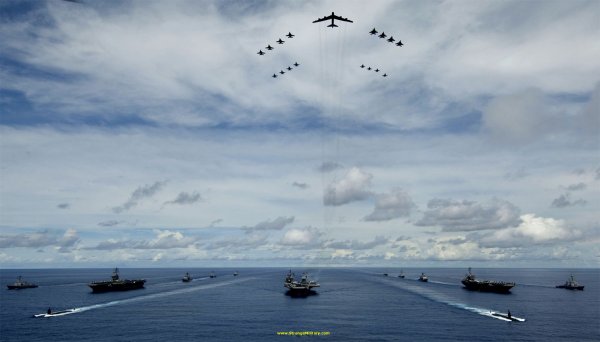
     Asia. Since the Communist Chinese took over China in 1949 there has been a secret war waged along the west side of the Pacific Rim. After that was the Soviet naval buildup under Admiral Gorshkov, that turned the Soviet Navy into a true blue-water navy. However, with the collapse of the Soviet Union (and it's navy) there is only one real Communist nation that poses a threat in the Pacific, the People's Republic of China. Just in the last few weeks China's president Hu Jintao urged the PLAN to prepare for combat. This comes as tensions continue to rise over the Spratley Islands in the South China Sea, and the PLAN stopped an Indian Navy ship just outside Vietnamese territorial waters. As China continues to buildup their military, the United States must respond. Here is what I believe the U.S. must do to stop China.
     1. Build new bases, and reopen old ones. Since the U.S. took over the Philippines from Spain in 1896, we operated Naval Base Subic Bay, and Clark Air Base a few miles away. However, after the 1991 eruption of Mount Pinatubo, Clark AB was covered in ash. The year after in 1992 the treaty leasing NB Subic Bay expired. Thus, the U.S. lost 2 very valuable bases located only 1100km from China. With the U.S. backing the Philippines in the Spratly Islands dispute, it would be in the Pilippines' and the U.S.'s best interests to reopen NB Subic Bay, and if possible Clark Air Base, as the former Clark Air Base is now Diosdada Macapagal International Airport. Also, the Marine Corps is in the process of stationing 2500 Marines near Darwin, this should be augmented with a full-fledged Air Force base and Naval Station in Australia, if the Australians are willing. Bases should also be established in Taiwan, and Singapore, existing bases on Guam, Hawaii, and Okinawa should be expanded.
     2. Cease the construction of "Supercarriers", and design and build a new class of aircraft carriers about the size of the USS Midway-class. In that last few years the Chinese have begun developing the DF-21D, as a means of denying most of the Western Pacific to U.S. aircraft carriers. This coupled with the proliferation of supersonic cruise missiles, and Kilo-class submarines poses a grave threat to U.S. naval air power throughout the Pacific. Furthermore, in this case quantity is better than quality, because at the moment if one carrier is lost there is a gaping hole the Navy's capabilities until the next carrier is completed. Thus, it is necessary that the Navy instead of building very few "Supercarriers", build a smaller class of carriers with a displacement not to exceed 65,000 tons, a max speed of 40 knots, and a complement of  50 aircraft. This is feasible as the USS Midway had a displacement of 62,000 and could carry 65 aircraft as of it's decommissioning in 1992. 
     3. Resurrect the Navy's ASW (Anti-Submarine Warfare) capability. During the Cold War the U.S. Navy was the best in the world at ASW. However, since the USSR collapsed in 1991 the Navy's ASW capability has gone down hill. This can be rectified by, 1. Extending the life of Perry-class frigates 2. Investing in more SOSUS systems and towed array sonars. 3. Developing a new class of frigates specifically for the ASW role.
     There is more that I will lay out in future posts, but the ideas I have laid out in this post, I believe are a good start to beating China and maintaining the U.S.'s national security.


Photo Credit: U.S. Navy

Thursday, September 1, 2011

The P-8 Poseidon: The New Sub-Hunter

     The P-8 Poseidon is a new ASW (Anti-Submarine Warfare) aircraft based off the Boeing 737 airframe, and is being produced for the U.S. Navy and the Indian Navy. the P-8 Poseidon is the replacement for the P-3 Orion which has served in the U.S. Navy and several other navies since 1962.
     In 2000 the Navy announced the Multimission Maritime Aircraft competition for a replacement for the aging P-3. Boeing and Lockheed were the original two competitors, but BAE Systems later entered as well, Boeing submitted a design based on the 737 airliner, Lockheed submitted a a modified version of the P-3, and BAE Systems submitted a new build version of the Nimrod MRA4. BAE later pulled out of the competition because it had a very small chance of winning the contract, as BAE is based of the UK and the U.S. military purchases most of it's equipment from U.S-based companies.  
     The P-8 has a range of at least 2222 kilometers (1381 miles), a top speed of 907 kilometers per hour (564 MPH), and a max altitude of 12.5 kilometers (41,000ft). The P-8 has an endurance of 4 hours on station, and a crew of nine. The P-8 can carry a range of weaponry including, Mk 54 anti-submarine torpedoes, AGM-86 Harpoon anti-ship missiles, SLAM-ER land attack missiles, and possibly air-to-air missiles. The P-8 is equipped with a sonobouy launcher, a magnetic anomaly detector, and several other types of ASW sensors. 
     The U.S. Department of Defense is planning to follow a plan similar to that of the F-35, by getting help from potential P-8 users. In 2008 Boeing proposed the P-8I for the Indian Navy to replace the Indian's aging Tu-142s (ASW version of the Tu-95 "Bear"). In 2009 the Indian Navy signed a contract for 8 P-8Is, and later signed a contract for an additional 4 P-8Is. Australia has shown some interest in the P-8 to replace their aging AP-3 Orions, and signed a memorandum of understanding that would allow them to gain access to the program and make suggestions about the program. The U.S. Navy is planning to buy up to 108 P-8s with full scale production starting in 2013.
     It will be interesting to see in the next few years what other countries purchase P-8s, especially the UK since the cancellation of the Nimrod  MRA4 leaves a large gap in the UK's ASW and maritime surveillance capabilities. It also be interesting to see how the P-8 performs against increasingly quiet Chinese submarines.
     
     
Photo Credit: U.S. Navy 


Monday, August 29, 2011

Is Support For The F-35 In Australia Weakening?

     Aviation Week reports that Australia is considering purchasing an additional 24 F/A-18E/F Super Hornets to bridge an air-power gap that will occur when Australia's older 71 F/A-18A/B Hornets are retired. If Australia does purchase the additional Super Hornets, it would be the second order they have made for Super Hornets.
     Australia has committed to purchasing at least 14 F-35s already, but if the order is decreased to the minimum, it would be a blow to the F-35 program overall as Australia decreasing it's order would be a high profile blow for the F-35.
     Up till the last couple of years Australia has been planning to purchase 100 F-35As to replace the aging Hornets, but when a RAND study came out that claimed the F-35 would be at a disadvantage against Chinese fighters support has started to weaken. On top of this, the present administration in Australia, and the last administration have both stated that they will not tolerate a decline in Australia's air combat capability. Thus, with the F-35 suffering from delays, and Australia's aging F/A-18A/Bs being retired, Australia will probably order the additional Super Hornets.
     Possible reasons for Australia replacing the F-35 with the F/A-18 would be the fact that the F-35A has a shorter combat range than the U.S. Air Force required, and range is an extremely important factor in the south Pacific as the distances are great in that area. Another reason could be that the F-35 has only 4 internal hardpoints for carrying ordnance and placing ordnance on the wing hardpoints would disrupt the F-35's stealth capabilities. Other possible reasons could include lack of maneuverability, speed, and high costs.
     Whatever the Australians choose in this matter it will be interesting to watch these events unfold, and as a result watch how Lockheed responds.


Photo Credit: U.S. Air Force